
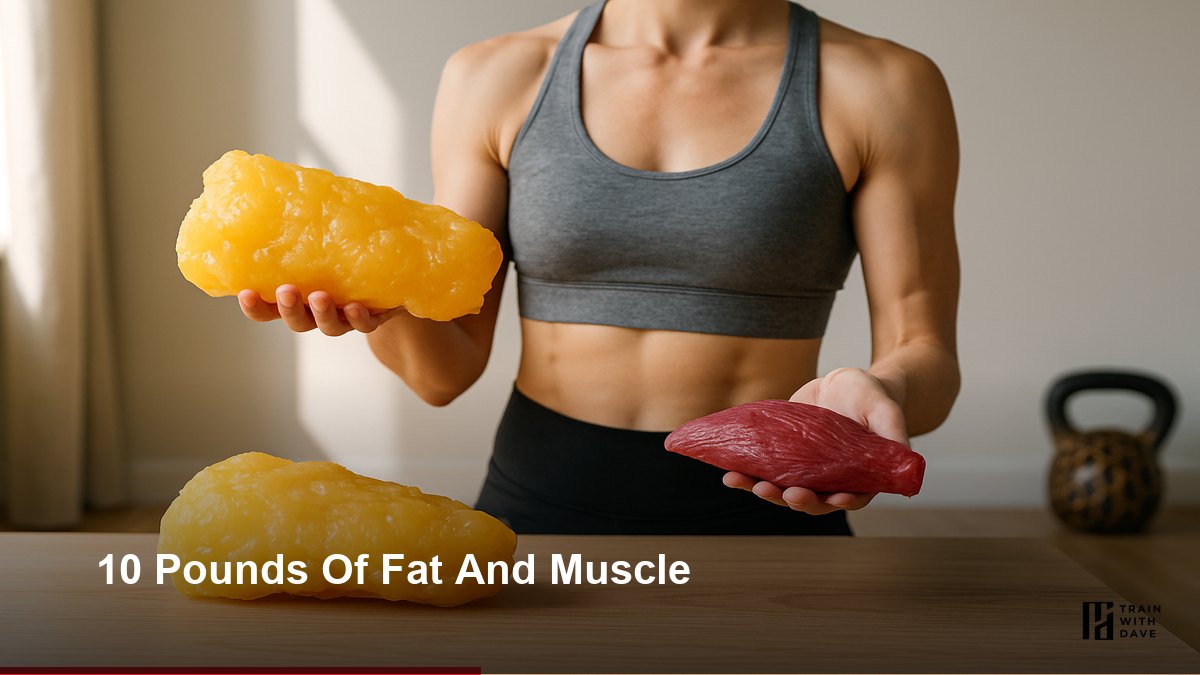
You step on the scale Monday morning, see the same number you saw last week, and your stomach drops. Then your jeans button without a fight. We see this contradiction every week at our Irvine studio — and it isn't really a contradiction at all. Ten pounds of fat and ten pounds of muscle weigh exactly the same, but they take up wildly different amounts of space on your body. When the scale stalls while your belt loop moves, your body is doing the right thing and your bathroom scale is the wrong tool to see it. Here's what 10 pounds of each actually looks like, and how to read what's really happening.
10 Pounds of Fat vs 10 Pounds of Muscle: The Volume Difference
A pound is a pound — but volume isn't. Body fat has a density of about 0.9 grams per cubic centimeter. Skeletal muscle clocks in around 1.06 g/cm³. That sounds like a small spread until you do the math: 10 pounds of fat takes up roughly 18 percent more space than 10 pounds of muscle. Picture a medium watermelon next to a slightly smaller cantaloupe. Same weight on a scale. Very different shape on your body.
Picture two visitors walking into our Orange studio at the same bodyweight. One is at 30 percent body fat, the other at 18 percent. Same scale reading, completely different silhouettes — different shoulder width, different waist, different jeans size. That's the volume difference doing all the talking.
It's also why a strong, well-trained 160-pound woman often looks ten pounds lighter in the mirror than a sedentary 160-pound woman. The lifter is carrying more dense muscle and less voluminous fat. Same number on the scale. Different body.
Harvard Health's primer on preserving muscle mass spells out why protecting that lean tissue is one of the most underrated levers for how you look and how you function as you age. We've broken down the same physics at a smaller scale in our post on what one pound of fat looks like compared to muscle — same rules, smaller canvas.
Why the Scale Lies When You're Doing Recomposition
Recomposition is the process of losing fat and building muscle at the same time. When it's working, the scale often does nothing for weeks. Clients walk into a session frustrated. We pull out the photos from four weeks ago, set them next to the new ones, and the room goes quiet.
The math is simple. If you drop 4 pounds of fat and add 4 pounds of muscle in a month, your scale weight is identical. But you've lost about 18 percent of the fat volume and replaced it with denser, more compact tissue. Your waist gets smaller. Your arms get tighter. Your face changes. The scale has no idea any of it happened.
There's another wrinkle: water and glycogen. Higher protein and harder training pull more glycogen into the muscle, and classic muscle-biopsy work by Olsson and Saltin in Acta Physiologica Scandinavica showed each gram of glycogen is bound to roughly three grams of water. That can swing your scale up to four pounds inside a single week with zero change in fat. A 2016 trial in the American Journal of Clinical Nutrition by Longland and colleagues tracked young men in a calorie deficit and found the high-protein, hard-training group lost more fat and gained more muscle than the lower-protein group on the same calories — the scale moved much less than the body did.
In our experience working with thousands of clients, the people who quit are the ones who only watch the scale. The people who win are the ones who learn to read the other signals.
What 10 Pounds of Muscle Actually Looks Like on Your Frame
Ten pounds of muscle is a transformation. It's almost never a single body part — it's distributed across legs, glutes, back, chest, shoulders, and arms. The big movers do most of the work, which is why squats, hinges, presses, and rows are the meat of every program we write at the studio.
What does it look like in real life? On a man, ten pounds of new muscle usually shows up as visibly fuller shoulders, a chest that fills the shirt, arms that show the line between bicep and tricep, and quads that round out a pair of pants. On a woman, it tends to show as defined glutes, shoulders that taper to the waist, and lower-body strength you can see when she walks.
Beginners can sometimes gain one to two pounds of lean mass per month if training, protein, sleep, and calories are on point. But for most natural lifters after the beginner phase, four to eight pounds of real muscle in a year is already strong progress. Scale weight can move faster, but that includes glycogen, water, food volume, and fat — not just new muscle. A 2018 meta-analysis in the British Journal of Sports Medicine by Morton and colleagues pooled 49 resistance-training trials and 1,863 lifters and pegged average gains in lean tissue at roughly 1.5 kg over the training window, with the protein benefit plateauing near 1.6 grams per kilogram per day — confirming that real muscle is built in months and years, not weeks. Anyone promising you 20 pounds in 12 weeks is selling you water and glycogen, not tissue.
Our coaches teach this as a multi-month project, not a multi-week one. We've broken down what the smaller jumps look like in our piece on what 5 pounds of muscle looks like — the rules don't change at 10 pounds, the canvas just gets bigger.
What 10 Pounds of Body Fat Actually Looks Like
Now flip it. Ten pounds of body fat takes up a noticeable chunk of real estate. Picture a medium watermelon, or about five quart-sized bags of butter packed together. That's the volume that disappears, slowly, when you put a pound of fat down each week.
Where it comes off depends on genetics, sex, and hormones — not on which exercise you did. Spot reduction is a myth. Your body doesn't oxidize fat from the spot you trained; it pulls from the entire pool, and your body decides where to grab from first. For most men, the belly is last off. For most women, the lower body tends to be last off.
There are two main categories worth knowing. Subcutaneous fat is the soft layer under the skin you can pinch. Visceral fat sits deeper, wraps around your organs, and is the one tied to metabolic risk. Harvard Health's primer on abdominal fat notes that visceral fat tends to come off first when you start losing weight — which is why your waist often shrinks before your hips or arms. That's a feature, not a bug.
Clients who walk into our Laguna Hills studio asking why their face is leaner before their thighs are getting that exact pattern. The fat is going. It's going from where the body is willing to spend it first.
Can You Really Lose Fat and Gain Muscle at the Same Time?
Yes — under specific conditions. Recomposition is most reliable for three groups: people new to lifting, people returning after a long layoff, and people carrying enough body fat that there's plenty of stored energy for the muscle-building project. Advanced lifters at low body fat usually have to pick one direction and commit to it.
The conditions that have to be true for recomp to work:
- Protein high enough to defend muscle in a deficit. The International Society of Sports Nutrition position stand on protein recommends 1.6 to 2.2 grams per kilogram of bodyweight per day for active people aiming to maintain or build muscle. For a 180-pound person, that lands around 130 to 180 grams a day.
- Resistance training, multiple times a week. Without progressive resistance work, a calorie deficit pulls from muscle as readily as fat. Strength work tells the body which tissue is worth keeping. Mayo Clinic's overview of strength training is a clean entry point on dose.
- A modest deficit, not a starvation deficit. Crash diets pull muscle. A 300 to 500 calorie daily deficit, paired with the protein and the lifting above, is the slowest road that actually keeps the muscle.
- Sleep that supports recovery. Seven hours minimum. Recovery is when the muscle gets rebuilt — the workout is just the signal.
The Longland trial we cited earlier put both pieces on the table — high protein and resistance training in a deficit — and the high-protein group lost more fat and gained more muscle than the lower-protein group, in the same calorie window. The diet wasn't doing it. The protein and the training were.
Stop Weighing Yourself Every Morning — Track These Instead
The bathroom scale measures one thing: how much your entire body weighs at one moment. It does not separate fat from muscle, water, or last night's salt. If you're doing the right work, the scale is the worst tool in your kit for the first three months.
Here's what we have clients track instead:
- A weekly weight average, not a daily number. Weigh in daily if you want, but only look at the seven-day average. That smooths out water swings.
- Tape measurements every two weeks. Waist at the navel, hips at the widest point, one thigh, one upper arm. Two of these moving down while the scale doesn't is the recomposition signature.
- Progress photos every four weeks. Same lighting, same angles, same time of day, same level of pump. Most clients can't see their own changes day to day; the photo can.
- Strength on the lifts. If your squat and your row are going up, your muscle is going up. The barbell doesn't lie.
- How clothes fit. Belt loops, collar buttons, sleeve tightness. The fastest, cheapest body composition test you have.
Logging the lifts is the underrated one. We walk every new client through this in our guide on how to start a workout journal for muscle gain — the people who write down their sets gain muscle faster than the people who don't, and it's not close.
How We Coach 10 Pounds in the Right Direction
Here's what twenty years of doing this with thousands of people has taught us: the slow road is the only road that sticks. People who try to lose 10 pounds of fat in a month either lose muscle along with it or rebound by month three. People who give themselves four to six months to drop 10 pounds of fat and add a meaningful chunk of muscle keep both for years.
The playbook we run with clients in Irvine, Orange, and Laguna Hills is boring on paper. Three to four resistance sessions a week, hitting every major movement pattern. Protein at 0.8 to 1 gram per pound of target bodyweight, spread across three to four meals. A small calorie deficit, not a punishing one. Daily steps as the cardio backbone, not endless treadmill sessions. Two photos and one tape measurement every two weeks. Adjust at the four-week mark, not the four-day mark.
Adherence beats accuracy. A client who hits 80 percent of a sane plan for six months will outperform a client who hits 100 percent of a perfect plan for three weeks. Every time. We'd rather you nail the next meal than try to recover from a missed one — that's the next-meal rule, and it's how we keep clients off the all-or-nothing treadmill.
If you want help building this for your body, schedule, and goals, we run a free 45-minute consult at any of our three Orange County studios. We'll talk through where you are, where you want to be, and which 10 pounds — fat off, muscle on, or both — would actually change your life.