
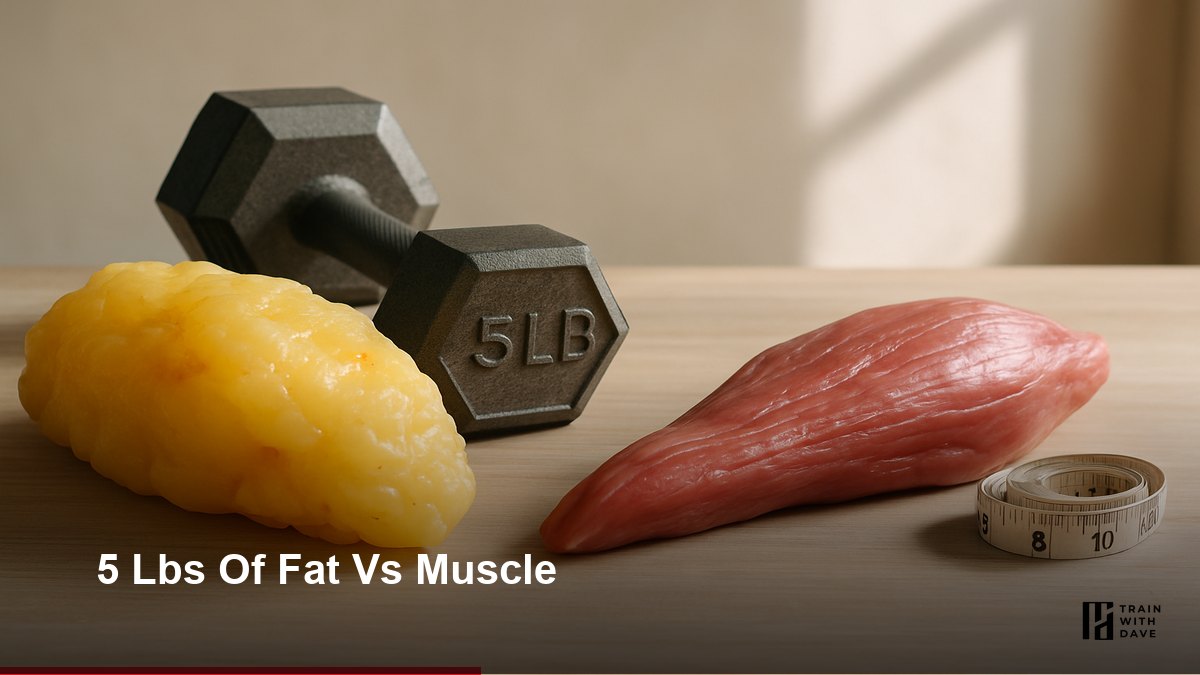
Here's the scene we see every week at our Orange County studios: a client walks in, the scale is the same number it was two weeks ago, and their jeans button without sucking in for the first time in three years. They want to know what's happening. The honest answer is the most important sentence in fat loss: the scale measures weight, not what your body is made of.
Five pounds of fat and five pounds of muscle weigh exactly the same. They do not look the same on your body, they do not take up the same space, and they do not behave the same way on a bathroom scale during a real transformation. The volume gap is real — fat tissue takes up roughly 18% more space than the same weight of skeletal muscle — and that gap is the single biggest reason people give up on a program right before it starts working.
Below: the numbers, what changes first, why the scale stalls during recomposition, and what to track so you don't quit three weeks before the payoff.
The volume problem: why 5 lbs of fat looks bigger than 5 lbs of muscle
This is chemistry, not character. Body fat (adipose tissue) and skeletal muscle have different densities, and that difference shows up as visible space on your body.
- Adipose tissue density: approximately 0.9 g/cm³
- Skeletal muscle density: approximately 1.06 g/cm³
These figures come from foundational human body-composition work cataloged by the U.S. National Library of Medicine's body composition reference and corroborated in more recent dual-energy X-ray absorptiometry (DXA) research. What that means in plain English: muscle is about 15% denser than fat. Same weight, less space.
Run the math on 5 lbs (about 2,270 grams):
- 5 lbs of fat ≈ 2,520 cm³ — roughly the size of a large softball or a thick paperback novel sitting on your hip
- 5 lbs of muscle ≈ 2,140 cm³ — about the size of a regular softball, more dense, more compact
That's a ~380 cm³ difference — about 18% more volume for the same weight of fat, distributed across your waist, hips, arms, and face. That's why someone who loses 5 lbs of fat and adds 5 lbs of muscle — net zero on the scale — looks measurably leaner.
The viral "fat blob is 3x bigger" gym props oversell it. The real gap is smaller — but still enough to drop a pant size without the scale moving.
Why the scale lies during recomposition
"Recomposition" is the technical name for what we just described: losing fat and gaining muscle at the same time. It's the holy grail of most fat loss goals, and it's exactly what your scale is worst at measuring.
The Mayo Clinic notes plainly in its guidance on muscle vs. fat weight that as you build muscle and lose fat, "you may look slimmer even if you weigh the same, because the muscle takes up less space." That's not a motivational quote — it's the mechanism. Here's what a real recomp looks like in someone training 2–3 times per week on a moderate calorie deficit:
- Week 1–2: Scale drops 3–6 lbs (water, glycogen, gut contents). Pants don't fit differently yet.
- Week 3–6: Scale stalls or moves 1 lb in either direction. Clothes start fitting better. This is where most people quit.
- Week 7–12: Scale slowly resumes downward (0.5–1 lb/week) but body looks dramatically different. Photos diverge sharply from "the number."
Across our Irvine, Orange, and Laguna Hills studios, the week 3–6 plateau is the highest-risk quit point. The scale stops cooperating right when the program is starting to work. If the scale is your only tool, it will fire you before you fire your fat.
What changes first — and what doesn't
The order things shift in a typical recomp, observed across two decades of in-person coaching:
- How you feel in the morning (weeks 1–2) — energy up, sleep better, less afternoon crash.
- Waistband notch (weeks 2–4) — belt or waistband moves before the scale meaningfully drops.
- Photos in the same shirt (weeks 3–6) — taken in the same lighting, same time of day. The biggest single tell.
- Body measurements (weeks 4–8) — waist, hips, and arms shrink even when total weight is flat.
- The scale (weeks 6+) — usually the last thing to budge consistently.
- Strangers and coworkers commenting (weeks 8–12) — a lagging indicator, but emotionally meaningful.
What does not reliably shift in 4–12 weeks: your BMI category, your resting metabolic rate, or how heavy you feel walking around. Those are real but slow — 6–12 month timelines, not 4-week ones.
What to track instead of (just) the scale
This determines whether someone quits at week 4 or transforms by month 4. Adherence beats accuracy. The right data beats the loudest data. The four-metric stack we use with TWD clients:
- Weekly photos. Same lighting, same angle, same outfit (or lack of one), same morning of the week. Front, side, back. Photos are immune to water weight, sodium swings, and time-of-month fluctuations. Nothing else is.
- Tape measurements every 2 weeks. Waist at the navel, hips at the widest point, one upper arm, one thigh. Five minutes total. A waist that drops 1.5 inches with the scale flat is fat down, muscle up — exactly what you want.
- Scale weight as a 7-day rolling average. Not a single morning weigh-in. Bodies fluctuate 2–5 lbs day to day. Average the noise out before you make a decision about it. The British Journal of Sports Medicine has published trial evidence that resistance training during caloric restriction preserves lean mass — meaning if you're lifting, expect the scale to undersell your fat loss because muscle is being protected.
- Strength in 2–3 key lifts. If your squat, hinge, and press are climbing while your waist is shrinking, you are recomping. Period. The scale doesn't get a vote.
None of these require a body fat scanner, a DEXA, or a $400 smart scale. The cheap version of this stack — a phone camera, a $4 tape measure, a kitchen scale, and a notebook — outperforms most of the expensive equipment because people actually use it.
The 5-lb tipping point: why people quit right before the payoff
The pattern we see over and over: someone joins, the first two weeks go well — scale drops, clothes feel different, momentum is high. Then weeks 3 through 5 hit. The scale stops. The internal voice says "this isn't working." Two missed sessions, one bad weekend, and the whole thing unravels.
What actually happened in those three weeks? They lost 4–5 lbs of fat and gained 4–5 lbs of muscle. Net zero on the scale, but their waist went down 1.5 inches and their lift numbers went up 15%. The program was working perfectly. The measurement tool was the problem.
Two decades of doing this has taught us a hard truth: people who quit fat-loss programs almost never quit because the program failed. They quit because their feedback loop was wrong. The scale fed them bad information at the worst possible moment.
The fix is mechanical, not motivational. Stop weighing daily and start photographing weekly. Measure your waist before you measure your weight. Judge the program on a four-week window, not a four-day one.
A simple "5-lb fat off, 5-lb muscle on" plan
If your goal is to lose 5 lbs of fat and add 5 lbs of muscle over the next 12–16 weeks — which is realistic for most non-beginners — here is the unglamorous framework that works. No extremes. No fasting protocols. No keto unless you genuinely like eating that way.
Training (the back-end product)
- 2–3 strength sessions per week. Full-body or upper/lower split. Compound lifts at the front of the session: squat, hinge (deadlift or RDL), push (press or push-up), pull (row or pull-up).
- Progressive overload, not exhaustion. Add 2.5–5 lbs to a lift, or 1 rep, every week or two. You don't need to crush yourself. You need to do slightly more than last time, repeatedly.
- Walk 8,000+ steps most days. Cheap, recoverable, and additive to your deficit. We don't ask clients to run unless they want to.
Nutrition (the lever that does most of the work)
- Protein at every meal. Aim for around 0.7–1 gram per pound of bodyweight per day. This is what preserves the muscle while you're in a deficit. It's also the most-overlooked variable in 90% of the failed fat-loss attempts we see.
- Moderate deficit — 300–500 calories below maintenance. Aggressive deficits eat muscle for fuel, kill your training output, and trash adherence. Slow is faster.
- 80–85 / 15–20. Eighty to eighty-five percent of meals built around whole foods you cooked or chose deliberately. Fifteen to twenty percent for restaurants, family dinners, weddings, and the life you actually want to live. No point in being lean if you're miserable.
Measurement (the part that prevents quitting)
- Same-conditions photos every Sunday morning.
- Waist + hip tape every other Sunday.
- Daily weight, but only look at the 7-day average.
- Log your top set on each compound lift weekly.
That's the whole thing. The reason this looks boring is because it works. The flashy stuff doesn't.
What this looks like in real Orange County clients
One of our Orange studio clients spent six weeks with the scale moving a total of 1.8 lbs. She nearly quit at week four. In that same window her waist dropped 2.25 inches, her squat went from bar-only to bar + 65 lbs, and her side-profile photo made the change obvious to everyone but her. She finished the 16-week block down 9 lbs on the scale and roughly 14 lbs of fat — because she added 5 lbs of muscle underneath.
That's the median outcome for clients who hold the line through the week 3–6 plateau. The scale was never going to tell her what was happening to her body. The waist tape and the photo did.
The bottom line on 5 lbs of fat vs 5 lbs of muscle
Same weight, very different bodies. Fat takes up about 18% more space than muscle for the same scale weight — enough to change a pant size and a side-profile photo without the scale moving. The scale is one tool, and during recomp it's the one most likely to lie. Add weekly photos, tape measurements, a 7-day rolling average, and a strength log — and the picture sharpens immediately. You will know whether your program is working. The scale alone will never tell you.
If you want this calibrated to your body, your schedule, and your goals — instead of figuring it out alone for the next six months — that's exactly what the free 45-minute consultation at our Irvine, Orange, or Laguna Hills studios is for. We'll look at where you are now, build the measurement stack with you, and map out the next 12 weeks. Book a free consultation here.
Related reading from the TWD blog
- What 5 Pounds of Muscle Looks Like — Why Small Gains Mean Big Wins
- What 1 Pound of Fat Looks Like Compared to Muscle
- How to Start a Workout Journal for Muscle Gain
FAQ
Is 5 lbs of fat really 3 times bigger than 5 lbs of muscle?
No — that's a viral exaggeration. The actual density difference is about 15% (fat ≈ 0.9 g/cm³, muscle ≈ 1.06 g/cm³), which makes 5 lbs of fat about 18% larger by volume than 5 lbs of muscle. That's plenty to change how clothes fit and how you look in photos, but it's not a 3x gap.
Can I really lose 5 lbs of fat and gain 5 lbs of muscle at the same time?
Yes, especially if you're new to lifting, returning after a layoff, or significantly overweight. Trained intermediates can still recomp but at a slower rate — typically 1–3 lbs of muscle and 5–10 lbs of fat across a 12–16 week block. Both directions at once is harder than fat loss or muscle gain alone, but absolutely doable with adequate protein and progressive resistance training.
Why is the scale not moving even though my clothes fit better?
Almost always because you're losing fat and gaining muscle at roughly the same rate. The mass on the scale is the same; the volume on your body is shrinking. Switch to weekly photos and a waist tape measurement before you switch your program. Most "stalls" are measurement-tool failures, not program failures.
How long until 5 lbs of muscle becomes visible?
For most people, 8–16 weeks of consistent strength training with adequate protein. The first 2–4 weeks are mostly neurological (you get stronger before you get bigger). Visible changes show up in side-profile photos around week 6–8 and become obvious to other people around week 10–12.
What's the best way to track progress if not the scale?
Weekly photos (same lighting, same outfit, same time of day), tape measurements every two weeks, a 7-day rolling scale average, and a weekly log of your top sets in the squat, hinge, and press. Four cheap data points beat one noisy one.
Where can I get personalized help with this in Orange County?
Train With Dave has studios in Irvine, Orange, and Laguna Hills. Every client gets a personalized training and nutrition plan built around their body, schedule, and the measurement stack above. Book a free 45-minute consultation at any location.