
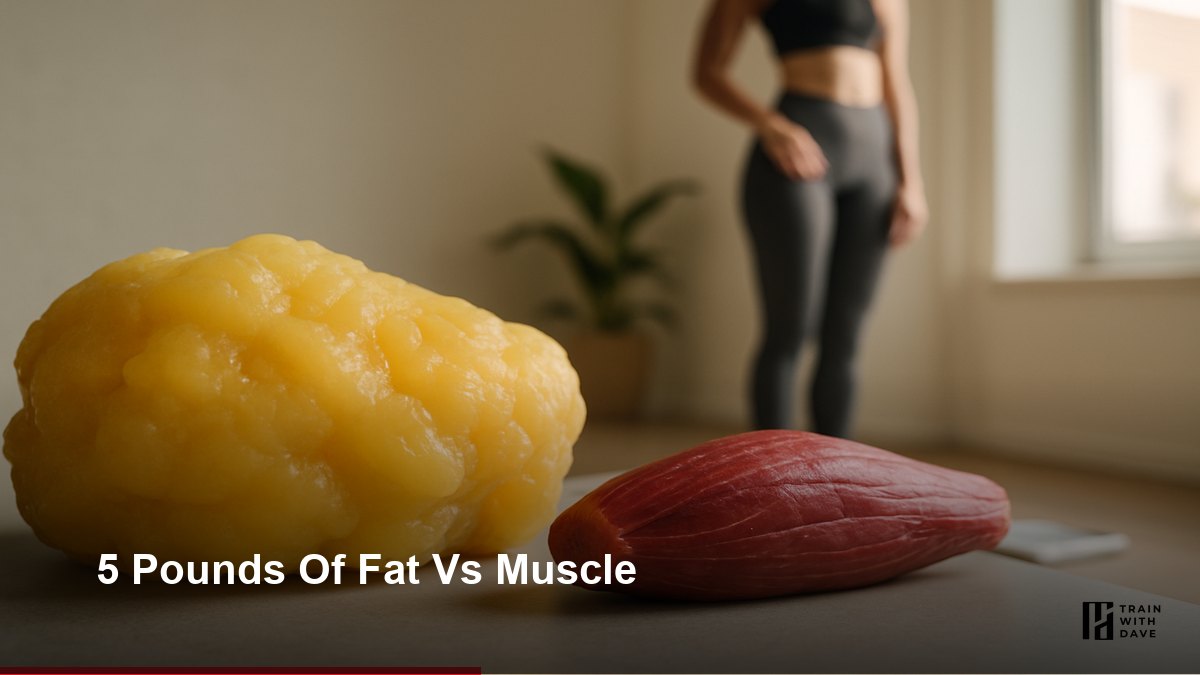
The scale dropped two pounds in twelve weeks. Your jeans dropped a full size. Most people assume one of those numbers is lying — and the wrong one usually wins.
Here's the truth: you probably swapped 5 pounds of fat for 5 pounds of muscle, and the scale doesn't measure that. The weight is identical. The volume isn't. Below we'll show you exactly what 5 pounds of fat vs muscle looks like on a real body, why the trade is the most underrated win in fat loss, and how to chase it without losing your mind every time you step on a scale.
The Scale Isn't Measuring What You Think It's Measuring
The scale weighs everything in your body the same way: muscle, fat, water, bone, glycogen, what you ate at lunch, what's still in your bladder. It's a single number for a body that has at least four moving parts.
A 170-pound person with 18% body fat looks nothing like a 170-pound person with 28% body fat — same number, totally different body. We see this every week at our Irvine studio when a new client steps on the scale, frowns at it, and then pulls up a photo from three months ago. The photo tells the truth the scale can't.
This is the part most clients miss for years before they walk in: the goal was never the number. The goal was what you wanted that number to represent — leaner, stronger, fitter, healthier. Once you separate the measurement from the goal, the strategy gets a lot clearer.
If you want a deeper view of how this same swap plays out at one pound, our breakdown of what 1 pound of fat looks like compared to muscle is the natural starting point. Five pounds is just that same trade-off, scaled up — and the visual difference is where it gets dramatic.
The Real Density Difference: Muscle vs Fat by Volume
You've seen the viral image: a soft yellow blob the size of a grapefruit next to a tight red brick of muscle the size of a tangerine. It's catchy. It's also exaggerated.
The actual density numbers, well-established in anatomical references and summarized in resources like the Cleveland Clinic's body composition overview, put muscle at roughly 1.06 g/mL and fat at roughly 0.9 g/mL. Muscle is about 18% denser than fat — not four times denser. Real, meaningful, but not as cartoonish as the meme.
Applied to 5 pounds, the volume difference is still big enough to matter:
- 5 pounds of fat ≈ about 2.5 liters of volume — picture a large soda bottle
- 5 pounds of muscle ≈ about 2.15 liters — closer to a small wine bottle
- The swap = roughly 350 mL of body volume saved — about a tall pint glass, redistributed across denser tissue
A pint of body volume removed and replaced with denser tissue, distributed across your waist, hips, arms, and legs, is enough to drop you a clothing size with zero change on the scale. That's the whole trick. The scale weighs both as 5 pounds. Your shirt does not.
What 5 Pounds of Fat Actually Looks Like on a Body
Five pounds of body fat doesn't sit in one place. Most of it is subcutaneous — directly under the skin around your midsection, hips, and thighs. Some of it is visceral fat, wrapped around your organs, which is the metabolically dangerous kind that's often the first to drop when you start training and eating well.
On a typical adult, losing 5 pounds of fat usually shows up as:
- About 1 to 1.5 inches off the waist — the most common first place you'll notice it
- Softening around the love handles and lower back visibly receding
- One belt notch tighter, or one full pant size if you were on the edge of two
- Sharper jawline and cheekbones — facial fat tends to come off early, which is why a lot of clients hear "you look great, did you cut your hair?" before anyone notices the body change
- Rings, watches, and bra bands fitting noticeably looser
In our experience working with thousands of clients across our Irvine, Orange, and Laguna Hills studios, the first 5 pounds of fat loss is also where adherence wins are quietly built. Clients who track their waist and not just their weight tend to stick with the program. Clients who only track the scale tend to quit at week three when the number lies to them for a few days in a row — usually right when their progress is actually accelerating underneath.
What 5 Pounds of Muscle Actually Looks Like on a Body
Five pounds of muscle is harder to picture in one spot because it doesn't lump anywhere — it distributes across your largest, hungriest muscle groups when you train them: glutes, quads, lats, hamstrings, and shoulders.
The visual signature shows up here:
- Shoulders look rounder and broader — the deltoids are small muscles but disproportionately visible
- Glutes look fuller and lifted — high impact for both men and women in how clothes drape
- Quads "pop" above the knee when you stand
- Lats widen the upper back, which makes the waist look smaller by contrast — the V-taper effect
- Better resting posture — a stronger upper back literally pulls your chest open and your shoulders back without you thinking about it
Our coaches teach this as a "shape change, not a size change." The pounds didn't move. The shape did. Our detailed breakdown of what 5 pounds of muscle looks like on the body covers the visual side in more depth, including before-and-after stories from clients who hit the swap and didn't believe the photos until they saw them side by side.
For the why behind that distribution, Mayo Clinic's overview of strength training spells out the basic rule: resistance work targets the muscle groups you train, and the visible change shows up where you put the work in. There's no shortcut, but there's also no mystery.
The Body Recomp Scenario: Same Weight, New Body
Here's where it gets fun. Imagine a 12-week stretch where you:
- Lose 5 pounds of fat
- Gain 5 pounds of muscle
- End at the exact same scale weight you started
Most people would call that 12 wasted weeks. They'd be wrong on every measure that matters except one — and that one measure isn't on the scale.
What actually changed in those 12 weeks:
- Waist: down 1 to 2 inches
- Body fat percentage: down 3 to 4 points
- Resting metabolic rate: up — muscle burns calories at rest, fat doesn't
- Strength on every lift: meaningfully up
- How clothes fit: dramatically better
- Progress photos: clearly leaner
This is body recomposition. It's the actual holy grail of fat loss, and it's also the reason we beg clients to take photos every four weeks. Harvard Health Publishing's piece on preserving muscle mass spells out the metabolic case: adults lose 3% to 8% of muscle per decade after age 30 without resistance training, and that loss is reversible. The 5-pound swap isn't just aesthetic — it's a metabolic asset you carry for life. Lose 5 pounds of fat and add 5 pounds of muscle, and you've fundamentally upgraded what the next decade looks like for your body, regardless of what the scale tells you on the day.
How To Chase the Swap (Without Losing Your Mind)
Here's the protocol our coaches teach in person. None of it is novel. All of it is hard to do for 12 weeks straight without help — but that's the part nobody wants to hear.
- Lift heavy, two to three times a week, minimum. Compound movements — squat, hinge, press, row — drive the majority of muscle response. Three full-body sessions per week beats six body-part splits for most people who aren't bodybuilders.
- Eat 0.7 to 1 gram of protein per pound of body weight, daily. The International Society of Sports Nutrition's position stand on protein and exercise places 1.4 to 2.0 g/kg (about 0.6 to 0.9 g/lb) as the working range for active adults, with the upper end recommended during fat loss to preserve lean mass. This is the single biggest lever in body recomp, and most people are getting half of what they need.
- Stay in a small calorie deficit — not a big one. Aggressive deficits eat muscle along with fat. A 250 to 500 calorie daily deficit lets you lose fat and add muscle simultaneously, which is the whole point of the swap. Crash diets win the scale war and lose the body-composition war.
- Progressive overload, tracked. If you're not gradually adding weight or reps over weeks, you're maintaining, not building. Our workout journal guide walks through the simplest version — one line per lift, one number to beat next time. You don't need an app. You need a number on paper.
- Sleep 7+ hours. Muscle repairs while you sleep, not while you train. Cut your sleep and you cut your gains, no exceptions, no caveats.
It's chemistry, not character. None of this requires willpower in the moment — it requires a system you don't have to think about. Build the system once, then just execute it.
Stop Weighing Yourself Daily — Or Do It Right
If the scale rules your mood, you've turned a measurement tool into an emotional weapon. Daily weight is noisy. Hydration shifts, sodium swings, glycogen changes, and what you ate yesterday can each move the scale 1 to 4 pounds in a day without a single change in your actual body composition.
The honest options:
- Weigh weekly, same day, same time, same conditions. One data point per week. Track the trend over a month, not the daily zig-zag.
- Or weigh daily and average it. Same time, same conditions. Then look at the 7-day rolling average, not the day-to-day. The average lies less than the daily reading.
- Add a tape measure. Waist, hips, chest, arm, thigh — every two weeks. Volume drops show up here before they ever show up on the scale.
- Take photos every four weeks. Same lighting, same time of day, same outfit, same pose. The mirror lies daily. Photos at four-week intervals don't.
This is the next-measurement rule we teach in our studios: the last weigh-in is over. The next one is in your control — and how you set it up determines whether you'll celebrate the work or quit at the next bad reading. Pick the measurement that actually reflects the work you're doing. For most people chasing the 5-pound fat-vs-muscle swap, that measurement is anything but the scale.
No point in being lean if you're miserable, and no point in tracking the number if it's making you miserable for no real reason. Build the trade-off — fat down, muscle up — and the right measurements will tell you it's working long before the scale catches up.