
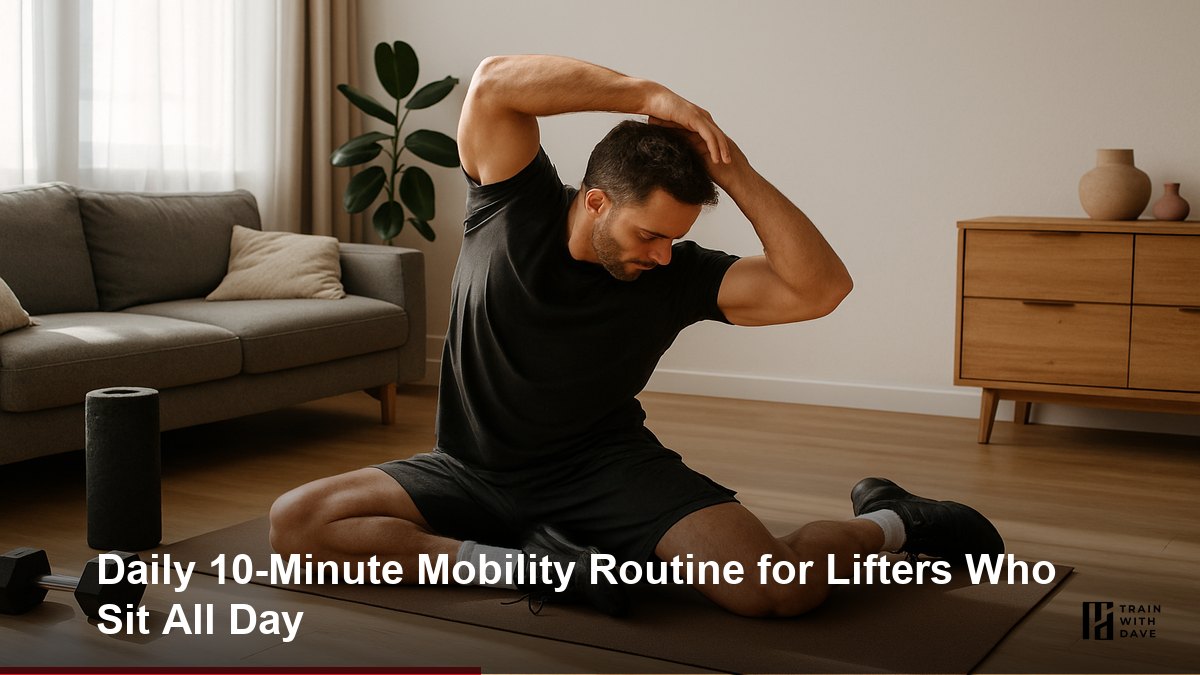
Here's the pattern we see constantly: someone trains hard three or four days a week, eats reasonably well, and still can't figure out why their squat won't hit depth, why the bar digs into their wrists on a front squat, or why pressing overhead feels like their shoulders are bolted shut. They assume it's a strength problem. It almost never is. It's a chair problem.
If you sit eight or nine hours a day — desk, commute, couch — you spend far more time folded into a chair than you do under a barbell. Your body is honest: it gets good at what you ask it to do most. Ask it to hold a 90-degree hip angle all day and it will happily shorten the tissue that keeps you there, then charge you for it the moment you try to sit into a deep squat or reach overhead. In twenty years of coaching thousands of clients, the single most common hidden brake on a desk worker's lifting isn't willpower or programming — it's range of motion they lost one sitting hour at a time.
The fix isn't an hour of stretching or a gadget. It's ten focused minutes a day, done consistently. Below is the exact daily routine our coaches teach lifters who sit for a living — no equipment, floor-based, and built to give you back the hips, mid-back, and shoulders your desk keeps taking.
Why sitting is a lifter's problem, not just a posture problem
Most articles about sitting talk about posture and back pain. Those matter, but for a lifter the cost is more specific and more frustrating: it shows up as a plateau you can't out-train.
Three areas take the hit, and they map directly onto the lifts people struggle with:
- Hips. Sitting keeps your hip flexors in a shortened position for hours. Tight hip flexors quietly limit how deep and upright you can squat and how well you extend at the top of a deadlift. This is the number-one restriction our coaches notice in new desk-worker clients.
- Thoracic spine (mid-back). Slumping toward a monitor rounds the upper back and stiffens it. A stiff T-spine is why the bar feels like it wants to roll off your shoulders on a squat and why the barbell drifts forward when you press.
- Shoulders. A rounded upper back drags the shoulders forward with it. That forward position is the difference between locking a weight out cleanly overhead and grinding it up with your low back doing the work.
The important idea: you're not permanently stiff. You're currently stiff because of what you did for the last eight hours. Range of motion responds to what you practice most often — which is exactly why a short daily dose beats a long weekly one.
Why 10 minutes beats a monthly stretching binge
People love the idea of a big Sunday mobility session. In practice it fails for the same reason crash diets fail — it's a spike, not a habit, and the body adapts to the average, not the outlier. Adherence beats intensity here.
Ten minutes is short enough that you'll actually do it on the busy days, which are the days that matter. The trick we teach clients is to anchor it to something you already do: run it right after you brush your teeth in the morning, or during the first work break of the day. Pre-decided, so you don't have to negotiate with yourself. In our experience, the lifters who improve are almost never the ones who found the perfect drills — they're the ones who found a slot in the day the routine could live in permanently.
The daily 10-minute mobility routine
Run these seven movements in order. The whole thing takes about ten minutes at an easy pace. Breathe slowly throughout — mobility work responds to relaxed, controlled breathing, not to forcing or bouncing. If anything produces sharp or pinching pain (as opposed to a stretch), back off and shorten the range.
1. 90/90 hip switches — 90 seconds
Sit on the floor with one shin in front of you and the other out to the side, both knees bent at roughly 90 degrees. Slowly rotate both knees to the opposite side and back, keeping your chest tall. This is the single best drill for undoing a day of sitting because it works the hip in rotation — the range chairs steal first. Aim for slow, controlled reps rather than how far you can force it.
2. Half-kneeling hip flexor stretch — 45 seconds per side
Drop into a lunge position with the back knee on the floor. Squeeze the glute of the back leg and gently shift your weight forward until you feel a stretch across the front of the hip and thigh of the back leg. Keep your ribs down — don't arch your low back to fake the range. This directly targets the tissue your desk shortens most.
3. Deep squat hold with a reach — 60 seconds
Sink into the bottom of a bodyweight squat, heels down, and hold. Use your elbows to gently push your knees out and, if you can, reach one arm up and rotate your chest toward it. This teaches your hips, knees, and ankles to be comfortable in the exact position your barbell squat needs. If your heels lift, hold onto something in front of you for balance and let gravity do the work.
4. Quadruped thoracic rotations — 45 seconds per side
On all fours, place one hand behind your head. Rotate that elbow down toward the opposite wrist, then open it up toward the ceiling, following the elbow with your eyes. This restores the mid-back rotation a monitor-hunched day flattens out. Move through a full, smooth arc rather than snapping to the end.
5. Cat-cow — 45 seconds
Still on all fours, slowly alternate between rounding your spine toward the ceiling and letting it sag as you lift your chest and tailbone. This isn't just a warm-up cliché — segment-by-segment spinal movement is one of the first things sitting takes away, and it's a gentle reset between the rotation drills and the shoulder work.
6. Wall slides — 60 seconds
Stand with your back, low back, and the backs of your arms flat against a wall, elbows bent at 90 degrees like a goal-post. Slide your arms up and down the wall while keeping contact. It will feel awkward and limited at first — that awkwardness is the tightness the exercise is addressing. This is the most direct carryover to a clean overhead lockout.
7. Dead hang — 30 to 60 seconds
Hang from a pull-up bar (or any sturdy overhead grip) with arms straight and let your bodyweight decompress your shoulders and spine. The dead hang is the quiet MVP of this list: it opens the shoulders overhead and gives the spine a moment of traction after a day of compression. No bar at home? Do it at the gym before you lift, and hold the wall slides a little longer in the meantime.
When to do it: three ways to fit it into a workday
The routine is the same; only the timing changes. Pick the one that fits your day and stick with it.
- Morning reset (best for most people). Ten minutes before you start work. You undo the overnight stiffness and start the day in a better position, before the chair gets its hooks in.
- Desk breaks. Split it up — 90/90s and the hip flexor stretch mid-morning, the T-spine and shoulder drills in the afternoon. Two five-minute doses fit into breaks you already take.
- Pre-lift warm-up. On training days, run the full routine, then repeat the two drills that map to the day's main lift — hip work before squats and deadlifts, wall slides and the dead hang before pressing.
You don't have to choose one forever. A pattern that works well for our clients is a short morning version daily, with the pre-lift version layered on top on training days.
Mistakes we see lifters make with mobility work
A few honest corrections from years of watching people do this well and poorly:
- Chasing a stretch instead of control. Cranking harder into a position doesn't teach your body to own it. Slow, controlled movement through a range you can actually stabilize is what sticks.
- Doing it hard for a week, then quitting. This is the big one. The lifters who see change treat it like brushing their teeth — small and daily — not like a project with a finish line.
- Skipping the mid-back. People fixate on hips and ignore the thoracic spine, then wonder why the bar still feels unstable on their back. The T-spine drills are not optional.
- Confusing mobility with a fix for pain. This routine is for stiffness from sitting. Genuine joint pain, tingling, or a limitation from an old injury is a different conversation — see our guide on how to restore range of motion after an injury before you push into a painful range.
How this connects to your lifts
None of this is mobility for its own sake. Better hip rotation and hip flexor length let you sit into a squat that's both deeper and more upright, which puts the bar over mid-foot where you're strong. A freer thoracic spine keeps the bar stable on your back and lets you keep your chest up under load. Open shoulders turn a grindy press into a clean lockout. The strength was already there — the routine just gives it a body that can express it.
If you want to know exactly where your own restrictions are before you start, our breakdown of mobility testing by age walks you through simple self-tests so you can prioritize the drills that will move the needle fastest for you.
Want your mobility and lifting built around your real schedule?
If you sit all day and lift on the side, a free 45-minute consultation at our Irvine, Orange, or Laguna Hills studio is the fastest way to find out which restrictions are actually holding your lifts back — and to get a plan that fits the hours you actually have. No pressure, just a real conversation about your goals.
Frequently asked questions
How long until a daily mobility routine actually improves my squat depth?
In our experience coaching lifters at our Orange County studios, most people feel a difference in warm-up quality within a week and see a real change in squat depth and overhead position in three to four weeks of daily 10-minute work. The gains come from consistency, not from any single stretch.
Should I do mobility work before or after lifting?
Both work. The most reliable approach is to run the full routine daily, separate from training — first thing in the morning or during a work break — and then use two or three of the drills as a targeted warm-up right before you lift.
Do I need any equipment for this routine?
No. The entire 10-minute routine is bodyweight and floor-based. The only optional add-on is a pull-up bar or sturdy overhead grip for the dead hang, which you can also do at any gym.
How much does personal training cost in Orange County?
Train With Dave averages $60 to $80 per session — and that includes your fully customized workout program, personalized nutrition plan, training app, and direct access to your trainer between sessions. Exact pricing is customized during your free 45-minute consultation.
Where are Train With Dave's studios?
Three Orange County locations: Irvine, Orange, and Laguna Hills. Free 45-minute consultations at each.