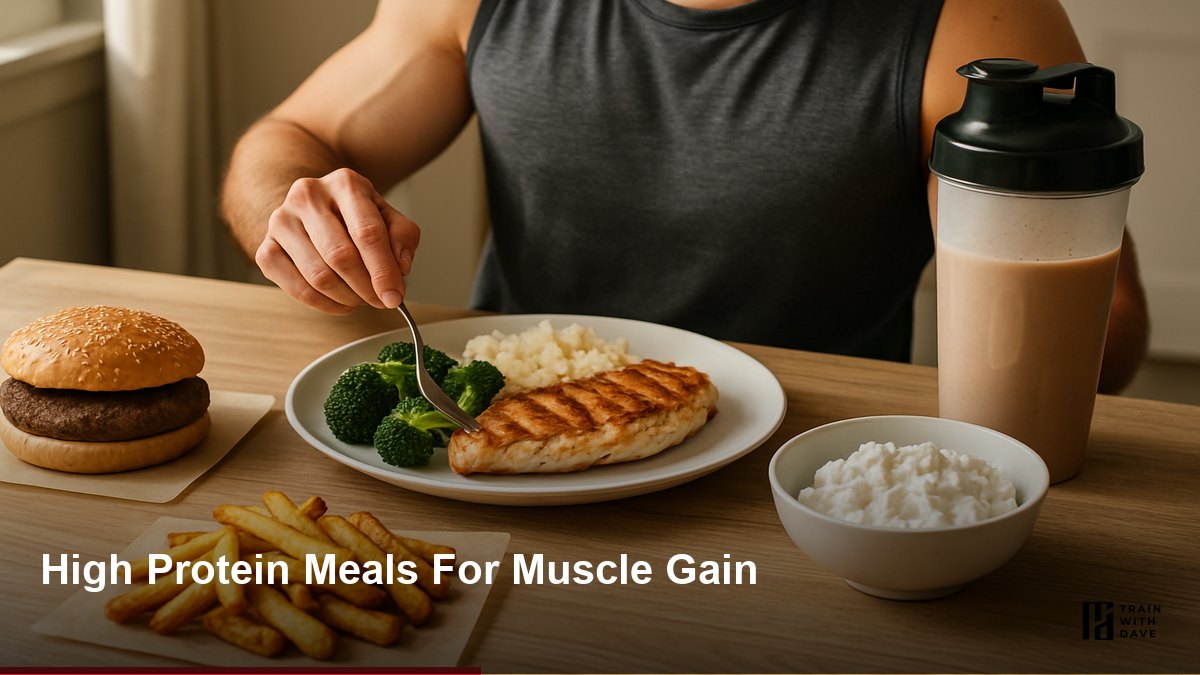
Putting on muscle without living off chicken, rice, and broccoli sounds like a fantasy — until you actually look at what's already on the menu at the chains you drive past every day. Most lifters under-eat protein during a gain phase because they think "high protein" means meal prep on Sunday. It doesn't. We see this every week at our Orange County studios — clients hit muscle goals while eating Chipotle, Chick-fil-A, and Panda Express two or three times a week. This guide is the exact list we'd hand a client trying to add lean mass without giving up restaurants.
How Much Protein You Actually Need to Build Muscle
Before you order anything, get the number right. The International Society of Sports Nutrition position stand on protein and exercise recommends 1.6 to 2.2 grams of protein per kilogram of bodyweight per day for people who lift hard and want to add muscle. Translated: a 180-pound lifter is aiming for roughly 130 to 180 grams of protein every day. Not "if I remember." Every day.
Here's where most people fail. They don't miss the daily total because the food is hard to find. They miss it because the protein is loaded into one giant dinner. A 2018 meta-analysis in the British Journal of Sports Medicine by Morton and colleagues found that resistance-trained adults plateau on muscle gains beyond about 1.6 g/kg — but only when protein is distributed across the day. Schoenfeld and Aragon's review in the Journal of the International Society of Sports Nutrition recommends roughly 0.4 g/kg per meal across four meals — about 30 to 40 grams per sitting for most lifters.
The other half of the equation is calories. To add muscle you need a small surplus, usually 200 to 300 above maintenance. A bigger surplus equals more fat, not more muscle. So the muscle-gain order isn't "the biggest meal on the menu." It's a meal that hits 35 to 50 grams of protein at a calorie cost your day can absorb. That's the lens for everything below.
Chipotle: The Muscle-Gain Bowl Build
Chipotle is the easiest chain on this list to engineer for muscle gain because every ingredient is portioned and modular. Chipotle's official nutrition calculator is the source for everything below — open it on your phone in the line and you can build to your exact macro target.
The bowl we'd hand a 175-pound lifter on a gain block: white rice, black beans, double grilled chicken, fajita veggies, fresh tomato salsa, roasted chili-corn salsa, and a half scoop of cheese. That lands around 920 calories with roughly 78 grams of protein. Add guacamole if you're under your fat target for the day — it bumps the meal to about 1,150 calories. For a leaner build during a fat-loss phase, see our companion guide on low-calorie Chipotle orders for cutting.
Two things from the floor. First, double protein is non-negotiable for a single-Chipotle muscle-gain meal. Single chicken is 32 grams — short of the per-meal target for most lifters over 170 pounds. Second, beans are not optional during a gain phase. Black beans add 8 grams of protein and 8 grams of fiber, which slows the meal and keeps your appetite stable until your next training-day meal.
What we tell our Orange County clients: order it the same way every time you go. Adherence beats accuracy. Pre-decided so you don't have to think.
Chick-fil-A: The Cheapest Way to 40+ Grams of Protein
Of every chain in this guide, Chick-fil-A wins on protein-per-dollar for muscle gain. Every figure below comes from Chick-fil-A's official nutrition page.
The simplest order: two 8-count Grilled Nuggets — 50 grams of protein, 260 calories total. That's a near-pure protein delivery system, useful when you've already eaten the calories you need from earlier meals and just need to backfill the daily protein number. Add a fruit cup and a Greek Yogurt Parfait without granola and you've engineered a 60-gram protein meal under 600 calories.
For a heavier muscle-gain meal, the Grilled Chicken Cool Wrap (43 grams protein, 660 calories) with an 8-count Grilled Nuggets on the side gets you to 68 grams of protein and 790 calories. Two of those a day plus a normal breakfast and a snack and a 200-pound lifter is well past their daily protein target without ever cooking.
The Cobb Salad with grilled filet (37 grams protein, 510 calories with the avocado lime ranch on the side) is what we'd recommend for a client who lifts at 5 PM and wants something that doesn't sit heavy after. Honey roasted BBQ sauce on the nuggets — order it on the side. The full container is 60 calories of mostly sugar; one tablespoon flavors the whole thing for 15. For a deeper rundown on what to order at every chain, our list of high-protein fast food orders that keep you lean and satisfied covers it.
Panda Express: Lean Entrée Doubles
Panda is misunderstood as a high-calorie chain. The Orange Chicken everyone defaults to is the problem, not the menu. Panda Express's official nutrition page shows their grilled and stir-fried entrées are some of the leanest restaurant proteins in the country.
Our muscle-gain bowl: brown rice base, double Grilled Teriyaki Chicken, side of Super Greens. That builds out to roughly 870 calories and 74 grams of protein. The Grilled Teriyaki Chicken alone is 36 grams of protein for 275 calories per entrée — roughly 0.13 grams of protein per calorie, which beats most "fitness" chains. Black Pepper Angus Steak (28 grams protein, 200 calories) is the other one we recommend often; the protein is slightly lower per entrée, but you can pair it with a String Bean Chicken Breast (14 grams, 190 calories) and get variety in the same plate.
What to skip during a gain block: Orange Chicken, Beijing Beef, SweetFire Chicken Breast, Honey Walnut Shrimp. Not because they're "bad foods" — there are no bad foods — but because they're inefficient delivery systems for the protein you came for. If a client really wants Orange Chicken, we tell them to order one entrée of Grilled Teriyaki Chicken first, then one Orange Chicken on the side. The double-entrée structure keeps the protein number on track while letting them eat what they actually want. We coach our clients on this approach in detail in our Panda Express high-protein order guide.
Subway, Wendy's, and McDonald's: Quick Hits for Travel and Road Days
None of these is a daily-driver muscle-gain meal, but every lifter eventually finds themselves at a freeway exit at 9 PM with no other option. Here's what to order when that happens.
Subway. A footlong Rotisserie-Style Chicken on multigrain bread with double meat lands around 740 calories and roughly 62 grams of protein, per Subway's official nutrition information. Double meat is the only modifier that matters for muscle gain — the standard portion is short. Skip mayo, ranch, and Subway Vinaigrette; mustard or red wine vinegar add flavor for almost no calories.
Wendy's. The Grilled Chicken Sandwich (34 grams protein, 350 calories) plus a small chili (15 grams protein, 240 calories) totals 49 grams of protein and 590 calories — a clean restaurant meal, per Wendy's nutrition and allergens page. The Asiago Ranch Chicken Club (39 grams protein, 660 calories) is another solid pick if you have more room in your day.
McDonald's. Two Egg McMuffins plus an Egg White Delight stack to roughly 770 calories and 49 grams of protein, per McDonald's nutrition calculator. For a non-breakfast option, the Artisan Grilled Chicken Sandwich is 37 grams of protein and 380 calories — slightly under the per-meal target, so add apple slices and a side salad with grilled chicken to round it out.
None of these is a perfect meal. They're all useful when the alternative is skipping a meal entirely — and a missed meal is the single biggest reason lifters under-eat protein during a gain phase.
A Real-World Weekly Rotation We Use With Clients
Here's what we mean by "muscle gain that fits real life." A 180-pound male client at our Irvine studio aiming for 170 grams of protein per day, eating four meals plus a post-workout shake. A typical week looks like this:
- Monday: Home breakfast (40g) → Chipotle double-chicken bowl for lunch (78g) → home dinner (40g) → post-lift shake (25g). Total: 183g.
- Tuesday: Greek yogurt + protein shake (50g) → home lunch (40g) → Chick-fil-A 12-count Grilled Nuggets + Cool Wrap (81g) → snack (15g). Total: 186g.
- Wednesday: Eggs and turkey bacon (35g) → Panda double Teriyaki + Super Greens (74g) → home dinner (45g) → shake (25g). Total: 179g.
- Thursday: Three home meals (155g total) → shake (25g). Total: 180g.
- Friday: Home breakfast (40g) → Wendy's grilled chicken + chili (49g) → date-night dinner (60g) → shake (25g). Total: 174g.
Three to four chain meals across the week. None of them perfect. All of them adequate. The weekly protein average lands at the gain target without anyone touching a meal-prep container.
Two principles do the heavy lifting here. First, hit the per-meal protein floor — about 35 grams — on as many meals as possible. That's the number we coach into our Orange County clients in their first month with us, and it's what separates lifters who put on lean mass from lifters who eat in a surplus and just get fluffier. Second, stop assigning moral weight to restaurants. Chipotle for a cut and Chipotle for a gain are the same restaurant — just built differently. The lifters who add ten pounds of lean mass in six months are not the ones with the most disciplined meal prep. They're the ones with the most repeatable restaurant orders.