
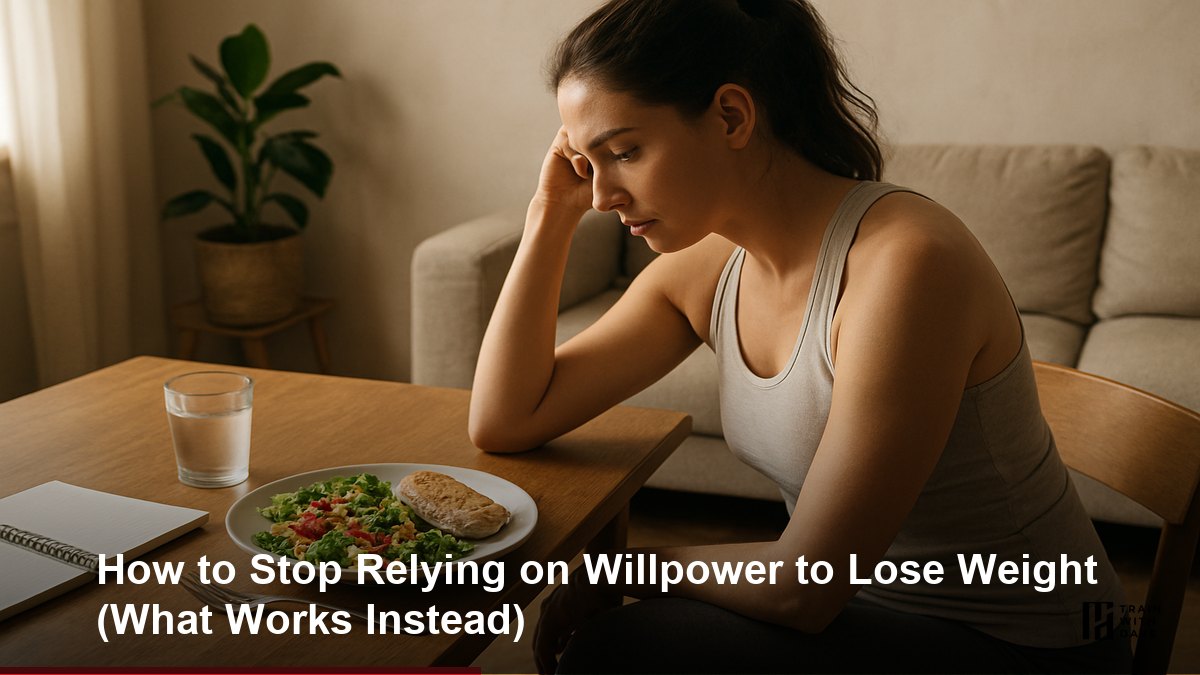
Willpower isn't the reason your last diet failed — and it's not the reason the next one will work, either. If you've ever white-knuckled a "clean" week only to unravel on Friday night, you probably told yourself the same thing everyone does: I just need more discipline. After twenty years of doing this with thousands of people, we can tell you it's the wrong diagnosis. The people who stay lean don't have more willpower than you. They've simply built a life that asks less of it.
Willpower is real, but it's a terrible foundation. It's a battery that drains over the course of a day, and by 8 p.m. — after work, traffic on the 405, the kids, and forty small decisions you didn't even notice making — it's nearly dead. That's not a character flaw. It's chemistry, not character. So instead of trying to be more disciplined, we're going to show you how to need less discipline.
Willpower is a battery, not a personality trait
Think about the last time you ate something you didn't plan to. Odds are it wasn't 9 a.m. on a calm Tuesday. It was late, after a long day, when you were tired, stressed, or both. That's not a coincidence.
Self-control is a finite resource that gets spent as the day goes on. Every choice you make — what to wear, what to answer, whether to merge — pulls from the same tank. By evening, the tank is low, which is exactly when most people ask it to do the heaviest lifting: resist the pantry, skip the drive-thru, say no to the second glass of wine. Stress makes it worse. As Harvard Health explains in its breakdown of why stress causes people to overeat, elevated cortisol pushes you toward the exact salty, sweet, fatty foods your plan says to avoid — and it hits hardest when your willpower is already spent.
So when someone tells us "I have no willpower at night," we don't hear a confession of weakness. We hear a scheduling problem. You're asking a dead battery to power a floodlight. The fix isn't a bigger battery — it's not needing the floodlight in the first place.
Why "just try harder" quietly sabotages you
Here's the trap: relying on willpower doesn't just fail, it fails in a way that feels like you failed. You skip the plan one night, decide you "blew it," and then blow it properly — the whole weekend, the whole week. This is all-or-nothing thinking, and in our experience it's the single most expensive habit a person can carry into a fat-loss goal. It turns one 300-calorie slip into a 4,000-calorie spiral.
The other problem is that willpower is invisible in the moment. You can't feel your battery draining, so you keep assuming tonight will be different. It won't be — not on willpower alone. What actually separates people who keep the weight off, in every case we've watched over two decades, is that they stopped trying to out-discipline their environment and started changing the environment instead. Adherence beats accuracy, every single time.
What works instead: five systems that don't need willpower
None of these require you to be a stronger person. They require you to make a handful of decisions once, in advance, when your battery is full — so the tired, stressed, 8 p.m. version of you doesn't have to decide anything at all.
1. Pre-decide your meals
The most powerful thing you can do is remove the decision. If you know what breakfast is before you're hungry, hunger never gets a vote. This is what we mean by pre-decided so you don't have to.
You don't need a rigid meal plan you'll hate by Wednesday. You need three or four defaults you actually like and can repeat: a go-to breakfast, two or three lunches, a handful of dinners, and — critically — a default order at the restaurants you already frequent. If you know that your In-N-Out order is a Double-Double protein-style, or that at Chipotle it's a chicken bowl loaded with fajita veggies and a scoop of black beans, you've turned a willpower moment into a reflex. The menu stops being a minefield.
2. Cut the number of choices
Decision fatigue is real, and the SoCal food landscape is engineered to exploit it. Every corner has a poke spot, a taco shop, a sushi bar, a smoothie place. More options means more decisions means a faster-draining battery.
So shrink the field on purpose. Keep the same five or six breakfasts on rotation. Shop from a short, repeatable grocery list. Pick your two "safe" restaurants for the week and let the rest be for special occasions. Repetition isn't boring — it's the whole point. Boring is what stays lean in February. As we tell clients at our Irvine studio every January, the goal isn't a diet that impresses people; it's a diet so unremarkable you forget you're on it.
3. Change the identity, not just the goal
"I'm trying to lose 20 pounds" is a goal that runs entirely on willpower — every choice is a fight against who you currently are. "I'm someone who eats protein first" is an identity, and identity runs on autopilot. The difference sounds small. It isn't.
When a client stops saying "I can't have that" and starts saying "I don't do that," something shifts. "Can't" is a restriction you're resenting. "Don't" is just a fact about you, like not smoking. We spend a lot of the coaching relationship helping people become the kind of person for whom the healthy choice is simply the normal one — because a normal choice costs no willpower at all.
4. Use the next-meal rule
You will get it wrong sometimes. You'll overeat at a party, or demolish the bread basket, or have a weekend that doesn't go to plan. The people who stay lean aren't the ones who never slip — they're the ones who slip and then stop, instead of slipping and then quitting.
The rule we give every client is simple: the last meal is over, the next one is in your control. There's no "ruined day," because a day can't be ruined — only the next decision matters, and it's always available. This one sentence has saved more transformations than any macro calculation we've ever run.
5. Draw the 80/20 line before you need it
Willpower dies fastest when the plan is all-or-nothing, because "all" is impossible to sustain and "nothing" is one bad night away. So don't build for "all." Build for roughly 80–85% of your meals being on-plan and 15–20% being genuinely, guilt-free off-plan.
When the pizza, the birthday cake, and the Friday margaritas are part of the plan instead of a betrayal of it, they stop requiring any resistance at all. In moderation there are very few foods that can harm your health or your physique. And frankly — no point in being lean if you're miserable. The 80/20 line isn't a loophole. It's the load-bearing wall.
A real Orange County day that runs on defaults
Here's what this looks like in practice, with almost no willpower spent:
- Morning: Same breakfast you have most days — Greek yogurt, berries, a scoop of protein. No decision. Battery untouched.
- Lunch out with coworkers in Irvine: You already know your order at the sushi spot — sashimi and a side of edamame, or a poke bowl heavy on fish and light on the crunchy toppings. You're deciding nothing at the table; you decided last week.
- Afternoon slump: Instead of the vending machine, there's a protein bar in your bag because it's always in your bag. That's a system, not a choice.
- Dinner, tired, don't want to cook: This is the danger zone — dead battery, high stress. But your default takeout is a Chipotle chicken bowl or a grilled plate from the Mediterranean place, and you order it on muscle memory.
- Friday: That's your 20%. Pizza and a couple of drinks with friends, fully planned, zero guilt. Saturday morning, the next-meal rule quietly resets everything.
Notice what didn't happen anywhere in that day: a heroic act of self-denial. That's the whole game. Steady, unglamorous consistency is what produces the 1–2 pounds per week that the CDC identifies as the sustainable, keep-it-off rate of weight loss — and it's the only rate that willpower-free eating can hold for months at a time.
How we coach this at Train With Dave
Nutrition programming is the easy part — anyone can hand you a calorie target. The hard part, and the reason people hire a coach instead of downloading an app, is building the systems around the target so the target actually gets hit on a normal, chaotic Tuesday.
When a new client sits down for their free 45-minute consultation at our Orange, Irvine, or Laguna Hills studio, we're not there to test their discipline. We're mapping their real life — their commute, their kids' schedules, the four restaurants they actually go to, the 8 p.m. crash — and then engineering defaults that make the right choice the path of least resistance. We will not tell you what to eat; we'll teach you how to eat, so that one day you won't need us at all. That's not a slogan. It's the entire methodology, and it's why our clients don't rebound the way crash dieters do.
You don't need to become a different, more disciplined person to lose the weight. You need a smarter design. Willpower is the most expensive, least reliable tool in the box — so we build you a life that barely uses it.
Ready to stop white-knuckling it?
Free 45-minute consultation at any of our three Orange County studios in Irvine, Orange, or Laguna Hills. We'll build the defaults, the go-to orders, and the guardrails around your actual schedule — so losing fat stops being a daily fight.
Book Your Free Consultation →Frequently Asked Questions
Is willpower completely useless for weight loss?
No — you'll need a burst of it up front to set up your systems and defaults. The point is that willpower is a poor long-term fuel because it drains daily and dies right when you need it most. Use it once to build the structure, then let habits and defaults carry the load.
What is decision fatigue and how does it affect eating?
Decision fatigue is the drop in self-control that comes from making lots of choices throughout the day. Every small decision spends from the same tank, so by evening you have far less capacity to resist temptation. Pre-deciding your meals removes food from the list of things you have to decide, which is why it works so well.
How do I stop the "I blew it, so I'll start Monday" spiral?
Use the next-meal rule: the last meal is over, and the next one is fully in your control. A day can't be "ruined" — only the very next decision matters, and there's always another one coming. One off-plan meal is a rounding error; quitting for the weekend is what actually stalls progress.
Can I still eat out in Orange County and lose fat?
Yes — that's the whole approach. Pick two or three restaurants you love, decide your default order at each in advance, and repeat them. When your Chipotle, sushi, or In-N-Out order is a reflex instead of a fresh decision, eating out costs you no willpower and no progress.
How does Train With Dave help with the mindset side, not just workouts?
Every plan is built around your real schedule, your real restaurants, and your real stress points — not an idealized week. Our coaches at the Irvine, Orange, and Laguna Hills studios engineer defaults and habits so the healthy choice becomes the easy one. Book a free 45-minute consultation to map yours.