
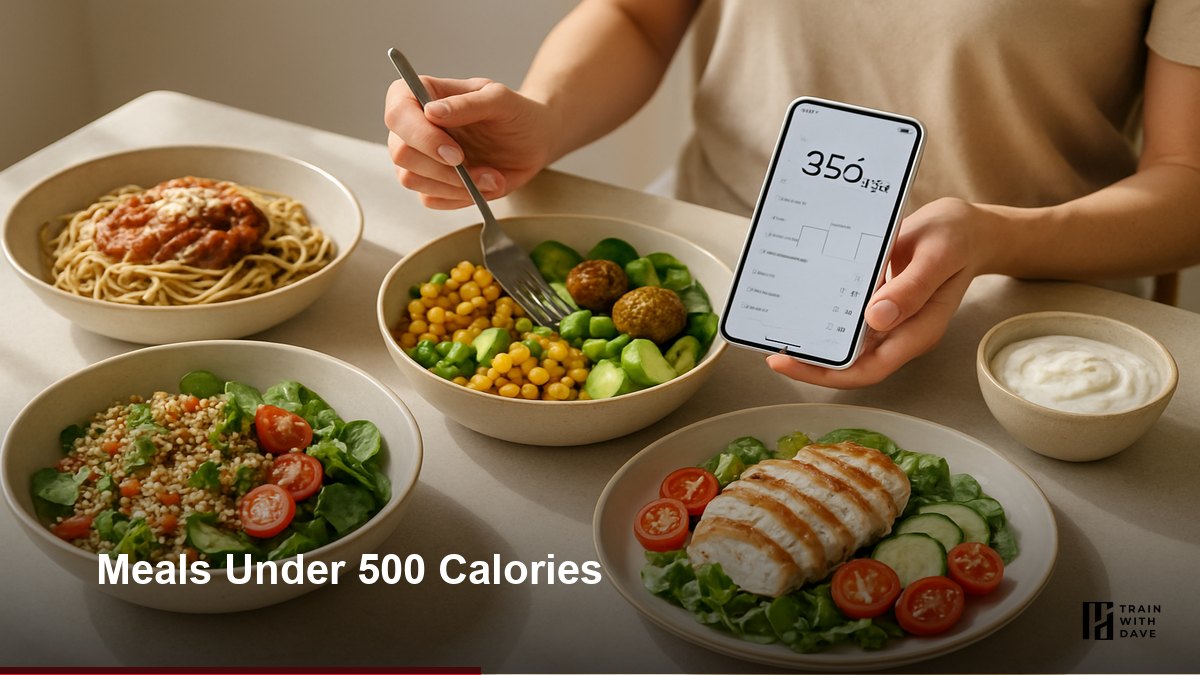
"Under 500 calories" sounds simple until you try to actually hit it. The salad you logged at 380 was 620. The "light" wrap was 740. The bowl you eyeballed at home? Closer to 800. The problem isn't willpower — it's that nobody taught you what 500 calories actually looks like on a plate, on a label, or on a menu. We've coached thousands of clients through this exact frustration at our Irvine, Orange, and Laguna Hills studios. Here's the field guide we wish every new client had on day one: what to track, what to ignore, and the plate formulas that land under 500 calories without a kitchen scale and a calculator.
What 500 calories actually looks like (and why most people guess wrong)
Calorie estimation is the most overconfident skill in fitness. A landmark 1992 New England Journal of Medicine study by Lichtman and colleagues found that participants underestimated their daily calorie intake by an average of 47% — and the people doing the underestimating were obese adults already trying to lose weight. That gap hasn't shrunk in the three decades since. We see the same pattern every week at our Irvine studio: a client logs "a small bowl of pasta" at 350 calories, sends us a photo of the actual plate, and we estimate the real portion at closer to 700.
Burn these into your head so you can build a meal in 30 seconds without a calculator. Roughly 500 calories looks like:
- A 4-oz grilled chicken breast (about the size of a deck of cards), ½ cup cooked rice, 1 cup roasted broccoli, and 1 teaspoon of olive oil.
- A Chipotle bowl with chicken on lettuce, fajita veggies, fresh tomato salsa, and pinto beans — no rice, no cheese.
- Two scrambled eggs plus two egg whites, half an avocado, and one slice of sourdough.
- A 6-inch Subway turkey on multigrain with all the veggies, mustard, and no cheese — plus a small apple.
- About 1.5 cups of pasta with marinara — and almost nothing else on the plate.
If you can recall those benchmarks, you can build a 500-calorie meal anywhere. If you can't, every meal becomes a guess, and the guess is almost always low.
The food-log mistake that turns 500 calories into 800
Food tracking apps don't fail because they're inaccurate. They fail because the user is. We've watched this play out with thousands of clients: someone logs "chicken Caesar salad" by selecting the top hit in a tracking app — a 380-calorie crowdsourced entry — when their actual salad was loaded with croutons, parmesan, and creamy dressing that pushed it past 700.
The four logging mistakes that quietly destroy a 500-calorie target:
- Cooking oil isn't free. A "drizzle" of olive oil is usually one to two tablespoons. That's 120–240 calories of pure fat you didn't log.
- Eyeballed protein is undercounted. What looks like 4 oz of chicken at home is often 6–7 oz raw. Weigh it once a week and recalibrate your eye.
- The condiment lie. Two tablespoons of ranch is about 150 calories. Ketchup is the only sauce most people guess accurately.
- "Sips and bites." A handful of almonds, a taste of your kid's mac and cheese, the cream in your coffee — none of these get logged. Combined, they're often 300+ calories a day.
The fix is unglamorous: weigh your food for two weeks, then trust your eye for the next two months. Recalibrate quarterly. This is the routine our coaches teach in person at all three of our Orange County studios, and it's the single highest-leverage habit a new client can build. A wearable that auto-logs your workouts can offset some of the cognitive load — but the food side still has to be done by hand, at least at first.
How to read a nutrition label in 8 seconds — the 3 numbers that matter
If you're scanning a Trader Joe's freezer aisle trying to decide whether dinner clears the 500-calorie bar, here's the three-number shortcut we teach: serving size, calories per serving, and protein per serving. Ignore everything else until you've checked those three.
The FDA's official guide to using the Nutrition Facts label emphasizes the same first step: always check the serving size before the calorie number. Most prepared foods quietly contain two servings — that "270-calorie" frozen burrito is 540 if you eat the whole thing, which everybody does.
Run through this in order:
- Serving size: read it first. Multiply if you're eating more than one.
- Calories per serving: anything over 350 in a single-component item (a frozen meal, a soup, a wrap) leaves you almost no room for sides.
- Protein per serving: aim for at least 25–30 grams. The International Society of Sports Nutrition position stand on protein recommends 1.6–2.2 g/kg/day for active adults, which works out to roughly 30 grams per meal across four meals for a 150-lb woman.
Calories alone tell you nothing about whether a meal will hold you. A 480-calorie smoothie with 8 grams of protein lands you back in the pantry by 2 PM. A 480-calorie chicken bowl with 38 grams keeps you flat until dinner. Same number, completely different result.
Restaurant meals that land under 500 calories (without the math)
Most "under 500" lists start in your kitchen. But Americans eat out several times a week on average, and that's where 500-calorie plans usually break down. Here's what we tell clients to order when they walk into the most-visited Orange County chains:
- Chick-fil-A: 12-count Grilled Nuggets plus a side salad with light Italian dressing — about 310 calories and 39 grams of protein. The single best protein-to-calorie ratio in fast food. All Chick-fil-A numbers in this post are from their official nutrition page.
- Chipotle: chicken bowl on lettuce, fajita veggies, fresh tomato salsa, pinto beans, no rice, no cheese — around 430 calories and 41 grams of protein. Chipotle's nutrition calculator lets you preview the full breakdown before you order. We have a longer walkthrough in our guide to the best low-calorie Chipotle orders for cutting.
- Panera: half Greek salad plus half chicken noodle soup — under 500 calories with around 25 grams of protein and enough sodium to make you actually feel full at 2 PM. Panera's nutrition page has the full numbers for any combo.
- Subway: 6-inch oven-roasted turkey on multigrain, all the veggies, mustard, no cheese, no mayo — about 320 calories and 19 grams of protein. Bump the meat to double for 25 grams and you're still under 400. Subway's official nutrition data lets you confirm the exact numbers for any build.
- In-N-Out: protein-style cheeseburger with no spread — about 330 calories and 18 grams of protein. Add a black coffee and you have lunch. In-N-Out's official nutrition info confirms the exact numbers.
Notice the pattern: a lean protein source, a low-calorie base (lettuce, a half-portion of bread, no rice), and salsa or mustard or vinegar instead of mayo or cheese or cream. Once you internalize that pattern, you can eat at almost any chain and clear the 500-calorie bar without pulling up a calculator. For more options at this same calorie ceiling, our roundup of 12 high-protein meals under 500 calories covers home cooking and meal prep.
The 4-part plate formula our coaches use at home
When clients ask us to build "a 500-calorie dinner," we don't give them recipes — we give them a formula. Recipes break the moment your grocery store is out of one ingredient. A formula doesn't.
The 4-part 500-calorie plate:
- 30–40 grams of protein — 5 oz of cooked chicken breast, lean ground turkey, salmon, shrimp, or extra-firm tofu. Weigh it cooked the first few times.
- One "volume" carb — 1 cup cooked rice, half a medium sweet potato, ½ cup pasta, or two corn tortillas. Pick one. Not two.
- Unlimited non-starchy vegetables — broccoli, peppers, zucchini, mushrooms, leafy greens, tomatoes. Fill the rest of the plate.
- One thumb of fat — 1 teaspoon olive oil, ¼ avocado, 1 tablespoon pesto, or 1 oz of cheese. Pick one.
That's it. The math works out to roughly 480 calories almost every time, give or take 50, with 30 grams or more of protein. We've been giving this formula to clients for fifteen years, and it survives every dietary preference: lower-carb (drop the starch, double the vegetables), plant-based (tofu plus lentils for the protein), or kid-friendly (chicken, rice, roasted carrots).
The reason it works isn't math — it's that the formula eliminates the three places people overshoot: too much fat (oils, cheese, nuts), too much starch (a "small" pasta serving is rarely small), and not enough protein. A 2015 review in the American Journal of Clinical Nutrition by Leidy and colleagues concluded that higher-protein diets improve satiety, body composition, and weight maintenance — which is exactly what this plate delivers without you tracking a single macro.
Under 500 isn't the goal — adherence is. Here's why.
Hitting "under 500 calories" for one meal is easy. Doing it across 21 meals a week, for 12 weeks, is what actually changes your body. And that's where most plans collapse.
We see two failure patterns at our studios so consistently we almost have names for them.
The first is the white-knuckle week. A new client locks in at 400 calories per meal for seven days, feels miserable, "treats themselves" on Friday, eats a 1,200-calorie dinner on Saturday, and writes the whole week off. Net calories: nearly identical to having eaten 600 a meal all week with no binge. The NIH's guidance on adult weight management emphasizes gradual, sustainable changes — not aggressive deficits that trigger the rebound. Our coaches teach this as the next-meal rule: the last meal is over. The next one is in your control. Don't try to fix Saturday with Sunday.
The second is the calorie banking trap — skipping breakfast and lunch to "save" calories for dinner. By 5 PM your blood sugar is in the basement, your decision-making is shot, and the 1,800-calorie pizza becomes inevitable. Three 500-calorie meals beat one 1,500-calorie meal every time, even when the totals match.
Here's what twenty years of doing this with thousands of clients has taught us: a 500-calorie meal you can repeat 200 times this year is worth ten 350-calorie meals you white-knuckle through and abandon by March. Adherence beats accuracy. Build the meal you'll actually eat in February when motivation is gone — not the meal that looks best in your tracking app today.
Frequently asked questions about meals under 500 calories
Are meals under 500 calories enough for an active adult?
For one meal, yes. Most active adults need 1,800–2,400 calories spread across three or four meals, so a 450–500 calorie lunch or dinner fits cleanly inside that window. The problem is when every meal is under 500 — that pushes most active adults into too aggressive a deficit and sets up the binge cycle described above.
Will I lose muscle eating under 500 calories per meal?
Not if you hit 25–30 grams of protein at that meal and lift weights two or three times a week. Muscle loss during a deficit is primarily a function of low protein intake and absent resistance training — not the calorie number itself.
How accurate do I really need to be?
Aim for plus or minus 50 calories per meal. Anything tighter is false precision; anything looser is the reason most food logs quietly fail. Weigh your protein and your fats; eyeball your vegetables.
Do I need a kitchen scale forever?
No. Two weeks of weighing recalibrates your eye for a few months. Re-weigh quarterly to fight portion drift.
What if I'm eating out and there's no nutrition info posted?
Default to: lean protein the size of your palm, vegetables the size of two fists, one carb portion the size of one fist, and skip the sauce or get it on the side. That structure lands under 500 the vast majority of the time without a single number being printed on the menu.