
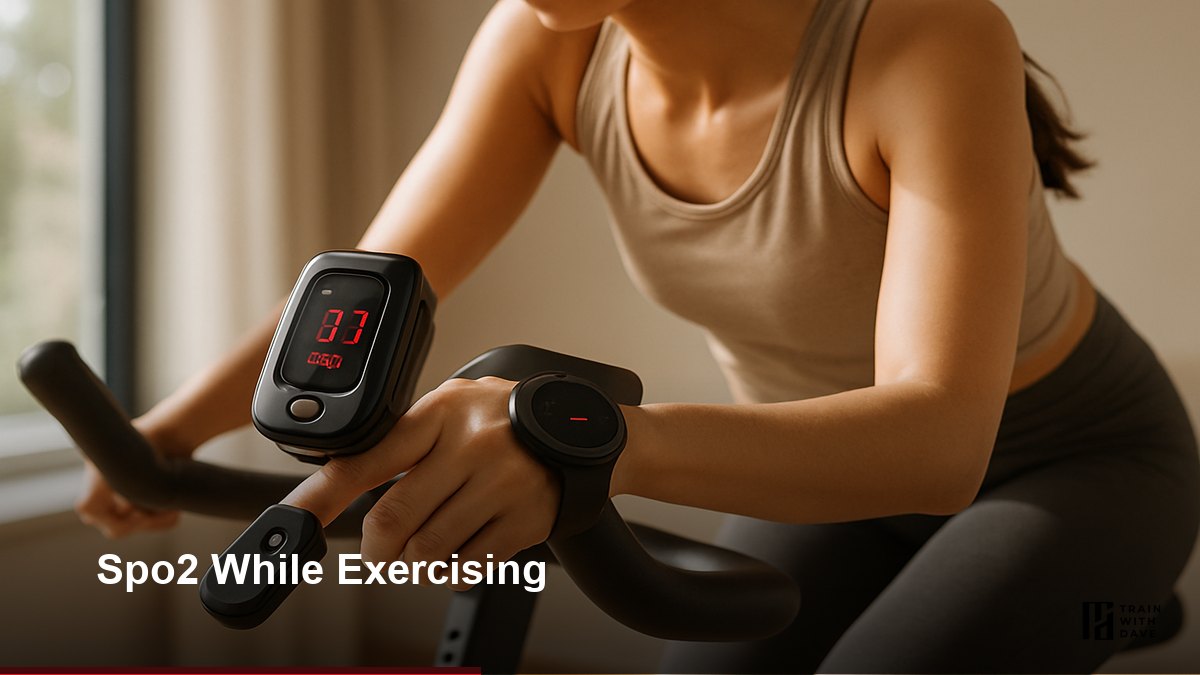
You finish a hard set of squats, glance at your watch, and the SpO2 reading flashes 92%. Did you just hypoxic-train your way to a PR, or did your wrist twitch at the wrong second? This is one of the most common questions our coaches get from clients who showed up wearing a brand-new Garmin or Apple Watch — and the honest answer is that SpO2 while exercising is the most misunderstood number on most wearables. Here's what the reading actually tells you, why most wrist-worn devices struggle with it mid-workout, and the use cases where the data is worth paying attention to.
What SpO2 actually measures — and why the number moves during a hard set
SpO2 is blood oxygen saturation: the percentage of hemoglobin in your red blood cells that's currently carrying oxygen. A healthy resting reading sits between 95% and 100%, according to the National Heart, Lung, and Blood Institute's overview of pulse oximetry. Consumer wearables estimate the number with reflectance pulse oximetry: an LED shines red and infrared light into your skin, a sensor reads how much bounces back, and an algorithm guesses the saturation based on the difference between the two wavelengths.
In our experience working with thousands of clients across Orange County, the misconception we untangle most often is the assumption that a lower SpO2 reading during exercise means something bad happened. It usually doesn't. Healthy adults frequently see brief dips into the low 90s during high-intensity intervals or heavy compound lifts — that's the body using oxygen faster than the lungs can resaturate the blood, which is normal and self-correcting within seconds.
What is a problem is a number that drifts down and stays down. Persistent readings under 90% during light effort can point to an underlying respiratory issue, and that's a conversation for your physician — not your trainer. The FDA's safety communication on pulse oximeter accuracy notes that even well-validated medical-grade devices can read several percentage points off from arterial blood gas measurement, and consumer wearables run looser than that.
Why wrist-worn SpO2 readings during exercise are usually noise
Here's the part wearable marketing tends to skip: SpO2 on a wrist-worn device during exercise is one of the hardest measurements in consumer tech, and most watches don't even try to give you a continuous reading mid-workout. They take a spot reading when you're still.
The reason is mechanical. Reflectance pulse oximetry depends on a tight, motionless seal between the sensor and your skin. Once you start moving — gripping a barbell, pumping your arms on a run, sweating heavily, flexing the muscle under the sensor — the optical signal degrades fast. The same FDA guidance flags skin pigmentation, nail polish, cold extremities, and motion as factors that all affect pulse oximetry accuracy. Exercise hits at least two of those at once.
Our coaches see this every week at the Irvine studio: a client finishes a set of deadlifts, gets a panicked-looking 88% on the wrist, and assumes something is wrong with their lungs. We sit them down, ask for five quiet breaths, and the number jumps back to 98% — because the original reading was an artifact of grip, sweat, and motion, not an oxygen problem. If you want a deeper look at where consumer trackers diverge from medical-grade devices, our breakdown on accuracy of SpO2 in smartwatches versus medical devices walks through the gap in detail.
When SpO2 during exercise is actually useful
There are a small number of scenarios where mid-exercise SpO2 tracking gives you real information instead of noise:
- Altitude training and travel. If you're hiking, cycling, or running above roughly 6,000 feet, SpO2 will dip predictably as ambient oxygen drops. A wearable can give you a rough read on how your body is adapting to elevation over a multi-day trip — not for action in the moment, but as a trend line.
- Breath-hold and hypoxic protocols. Swimmers and freedivers using deliberate hypoxic training benefit from a baseline number, though they almost always use a fingertip oximeter rather than a wrist watch for the precision.
- Post-illness return to exercise. The CDC, Mayo Clinic, and pulmonologists all flag persistent low SpO2 as one of several signals to bring to a doctor during recovery from a respiratory infection — the data point matters here because the baseline has changed.
For the other 95% of strength and conditioning use cases, SpO2 during a working set is not actionable data. The number that is worth tracking, even on a consumer watch, is your resting and overnight SpO2 trend — which we'll get to below. Our deeper dive on how athletes use SpO2 data for better recovery covers the recovery side of the conversation, because that's where the signal is genuinely cleaner than the mid-workout noise.
Trackers and watches that handle SpO2 better than most
If you've decided SpO2 matters for your training context — altitude, recovery monitoring, sleep screening — the device matters more than the brand marketing suggests. A few patterns hold up consistently across the consumer wearable category:
- Garmin (Fenix, Forerunner 965, Venu, Epix lines) offers the most configurable SpO2 monitoring on the wrist, with on-demand spot readings and continuous overnight tracking. The trade-off is battery life burns faster with continuous SpO2 turned on — pick the model with headroom. Our breakdown of the top fitness trackers with long battery life walks through the specific models that hold up over multi-day wear.
- Apple Watch (Series 6 and later, where the feature is enabled) takes SpO2 in roughly 15-second spot checks. Regulatory changes have removed the feature from some new U.S. units, so verify current capability on Apple's support page before buying specifically for SpO2.
- Whoop and Oura measure SpO2 during sleep only — no on-demand readings — which is honest design for a recovery-focused product and removes the temptation to misread a mid-workout artifact.
- Fingertip pulse oximeters (Masimo MightySat, Nonin Onyx) remain more accurate than any wrist device for spot readings. If clinical-grade accuracy actually matters in your situation, Cleveland Clinic's overview of pulse oximetry walks through what to look for in a device.
The general rule we give clients: if you need a number you can act on medically, use a fingertip oximeter. If you want a trend, the wrist is fine — just respect the limits of what the trend is telling you.
How we coach clients who fixate on their SpO2 numbers
A growing share of new clients walk into our Orange studio with a wearable on, a screenshot from the app, and a question about why their SpO2 dipped during a workout. Our coaches teach the same rule every time: one number on one screen on one day is not a training signal. A trend across two weeks is.
The framework we use:
- Ignore single mid-workout readings unless they consistently drop below 90% across multiple sessions in low-altitude, healthy conditions. That's a doctor's-office conversation, not a programming conversation.
- Look at overnight SpO2 trend across 14+ nights. A stable 95–99% overnight average is the green light most lifters need. Frequent dips below 90% at rest are worth flagging to a physician — sleep-disordered breathing is one of the most common, undertreated reasons for plateaued recovery we see in men over 35.
- Pair SpO2 with the data that actually moves your training — sleep duration, resting heart rate, HRV trend, bodyweight trend. SpO2 in isolation tells you almost nothing about whether you're ready to train hard tomorrow.
This is the same advice we give clients on every other data point a wearable produces: context first, single readings last. Twenty years of doing this with thousands of people has taught us that clients who lean on one metric — SpO2, HRV, scale weight, whatever the screen of the month is — almost always burn out on it inside three months. Clients who treat the wearable as a journal entry rather than a verdict keep using it for years.
Recovery, sleep, and the SpO2 signal that actually matters
Here's where the data earns its keep. Overnight SpO2, averaged across two weeks, can flag sleep-disordered breathing — and sleep-disordered breathing is one of the most under-diagnosed obstacles to fat loss, strength gains, and steady energy that we see across our client base. According to the National Heart, Lung, and Blood Institute's sleep apnea page, tens of millions of U.S. adults have obstructive sleep apnea, and a large share are undiagnosed.
A wearable that flags repeated overnight SpO2 dips into the 80s is not diagnosing sleep apnea — only a clinical sleep study does that — but it is giving you a reason to ask your doctor for one. We've watched a meaningful number of clients hit a recovery wall, get a sleep study after a wearable flagged the pattern, get diagnosed and treated, and inside two months see strength PRs that hadn't moved in over a year.
That's where SpO2 earns its place in the training conversation: not as a real-time workout dial, but as a longitudinal recovery signal that occasionally surfaces something genuinely worth medical follow-up. The same logic applies at altitude — a multi-day SpO2 trend tells you your acclimation status better than any single reading ever will, which is the actual coaching use case.
The honest takeaway
If you're a healthy adult lifting and conditioning at sea level, SpO2 during your workout is one of the least useful numbers your watch shows you. Don't waste mental energy on it.
If you train at altitude, are returning from a respiratory illness, or have a wearable that consistently flags overnight dips, SpO2 is worth tracking — but as a multi-week trend, not a moment-to-moment readout. And if any of those flags persist, the next step is your physician, not a different watch.
Our 80/15–20 rule applies here the same way it does to nutrition. About 80% of the training-and-recovery wins come from sleep, calories, protein, and consistent training. The remaining 15–20% is where biofeedback like SpO2, HRV, and resting heart rate can fine-tune things at the margin. Most lifters spend their attention upside down — obsessing over the margin and ignoring the basics. Get the basics right first, then let the watch be a quiet co-pilot in the background. The wearable industry will keep adding sensors, and the honest answer to most "what does this number mean?" questions will keep being: less than the marketing suggests, but more than zero — and only when you read it the right way.