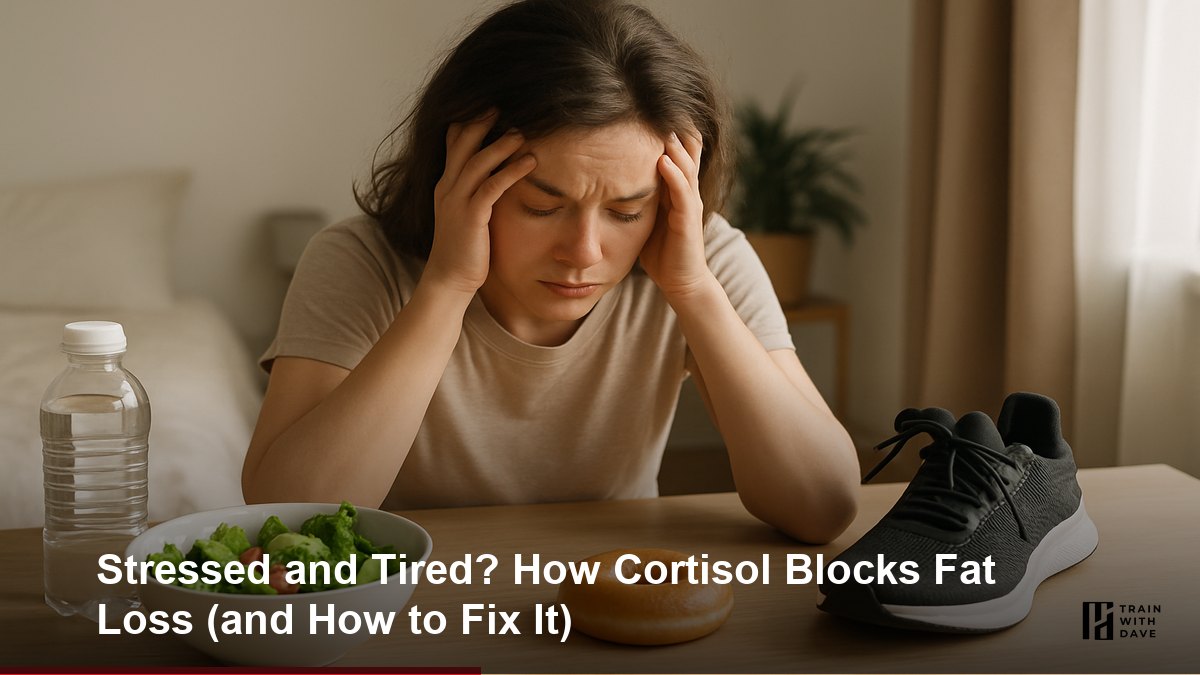
You're eating less, training more, and the scale hasn't moved in three weeks. You're also sleeping five hours a night, running on coffee, and answering work emails at 10 PM. Those two facts are connected. In our experience working with thousands of clients at our Irvine, Orange, and Laguna Hills studios, chronic stress is the most common reason a perfectly reasonable fat-loss plan stops producing results — and it's the lever almost nobody talks about. This post explains what cortisol actually does, the three specific ways it stalls fat loss, and the fixes we give stressed, tired clients. Fair warning: none of them involve training harder.
What Cortisol Actually Is (and Isn't)
Cortisol has become the internet's favorite villain, so let's start with what it really does. Cortisol is your body's primary stress hormone, and according to the Cleveland Clinic's overview of cortisol, it helps regulate your metabolism, blood sugar, blood pressure, and sleep-wake cycle. It's the reason you wake up in the morning and the reason you can lift heavy or sprint when you need to. You would not survive without it.
The problem is not cortisol. The problem is cortisol that never comes back down.
Your stress system was built for short bursts — see the threat, mobilize energy, deal with it, recover. A hard workout is exactly that pattern, which is why training is a healthy stressor. But a 60-hour work week, a phone that buzzes until midnight, a long commute on the 5, and five hours of sleep is a different pattern: the alarm never shuts off. When stress stays chronic, MedlinePlus's guide to stress and your health links it to obesity, anxiety, depression, and trouble sleeping — a list that reads like everything standing between you and fat loss.
Here's the reframe we give clients: if you're stressed, tired, and craving a burrito at 9 PM, that's not a discipline failure. It's chemistry, not character. And once you treat it as chemistry, it becomes a solvable problem instead of a personal flaw.
The Three Ways Chronic Stress Blocks Fat Loss
Cortisol doesn't suspend the laws of thermodynamics. You still lose fat in a calorie deficit. What chronic stress does is quietly attack the deficit from three directions at once.
- It turns up hunger and points it at high-calorie food. Short, acute stress kills appetite. Sustained stress does the opposite — Harvard Health's explainer on stress eating describes how elevated cortisol increases appetite and steers cravings toward sugary, high-fat comfort food. That's why nobody stress-eats grilled chicken and rice. The 300-calorie deficit you built on paper gets erased by a few "it's been a day" decisions you barely remember making.
- It makes you move less without noticing. A huge share of your daily calorie burn is non-exercise movement — walking to the far parking spot, taking stairs, pacing on calls, fidgeting. When you're exhausted, all of that quietly shrinks. You take the elevator, skip the evening walk, and sit more. Same workouts, hundreds fewer calories burned per day, and it never shows up in a training log.
- It hides the progress you ARE making. Elevated cortisol promotes water retention. Clients who are genuinely losing fat can hold enough extra water during a brutal work stretch that the scale reads flat for two or three weeks. Then they conclude the plan "isn't working," abandon it, and eat their way back to the starting line. The plan was working. The measurement was lying.
Notice that all three are behavioral or measurement problems, not a magical metabolic shutdown. That's good news — behavior is fixable.
The Sleep Piece Is Bigger Than You Think
If we could only fix one thing for a stressed client, it would be sleep — before macros, before cardio, before anything trendy.
A foundational 2010 trial in Annals of Internal Medicine put dieters through the same calorie deficit under two conditions: 8.5 hours in bed versus 5.5 hours. The short-sleep group lost 55% less fat, and more of their weight loss came from lean mass instead. Same food, same deficit — sleep changed what they lost. If you're grinding through a diet on five hours a night, you're paying full price for half the result.
Short sleep also feeds the stress loop directly: you wake up already tired, cortisol runs higher, cravings run louder, willpower runs lower, and the day's food decisions get worse from breakfast on. We see this every week at our Irvine studio — the client whose food log falls apart is almost always the client whose sleep fell apart first.
What we actually ask clients to do:
- Pick a consistent sleep window and protect the start time like a meeting. Aim for 7–9 hours in bed.
- Set a caffeine cutoff around noon to 2 PM. The afternoon cold brew is a loan against tonight's sleep.
- Get the phone off the pillow. Charge it across the room. The doom-scroll is a cortisol appetizer right before bed.
- Keep the room cold and dark. Boring advice, undefeated results.
Why "Just Train Harder" Backfires
The instinct when the scale stalls is to add: more cardio, more sessions, a 5 AM bootcamp on top of everything else. For a stressed, under-slept person, this usually makes things worse, because training is itself a stressor that draws from the same recovery budget as your job and your sleep debt. We broke down the mechanics in our post on what prolonged exercise does to cortisol — long, punishing sessions stacked on chronic life stress just pile more load onto a system that's already maxed out.
You feel this as the classic overcooked pattern: wired at night, dead in the morning, sore for days, irritable, and somehow softer-looking despite training six days a week.
Here's what twenty years of doing this with thousands of people has taught us: the stressed client who lifts three times a week, walks daily, and sleeps seven hours beats the stressed client who trains six days and sleeps five — every single time. Strength training earns its place because it defends muscle while you lose fat and it ends. Forty-five focused minutes, done, recover. It's the open-ended "punish myself on the treadmill because the scale didn't move" sessions that backfire.
This is exactly why we program differently for high-pressure careers — we wrote about that approach in our post on personal training for executives with high-stress careers. The workout has to fit inside the life, or the life will eventually delete the workout.
How to Eat When You're Stressed and Tired
Stress eating is a decision-fatigue problem more than a knowledge problem. You know what a reasonable dinner looks like. At 8 PM, after eleven hours of decisions, you just don't have the executive function left to build it from scratch. So we remove the decision.
- Pre-decide your meals — especially the vulnerable ones. Our coaches teach clients to script the meal that usually goes sideways (for most people, dinner or the 3 PM crash) before the day starts. Pre-decided so you don't have to. A Chipotle bowl you ordered in the app at lunch beats whatever you'd improvise at 8 PM.
- Anchor every meal with protein. Protein is the most filling macronutrient per calorie, and appetite control is the whole battle when cortisol is turning hunger up. Build the plate around the protein first; let everything else fill in behind it.
- Use the next-meal rule. The last meal is over. The next one is in your control. Stress eaters don't get destroyed by one comfort meal — they get destroyed by the "I already blew it" spiral that turns one meal into three bad days.
- Stop labeling foods good and bad. There are only higher-calorie and lower-calorie choices, more and less filling ones. In moderation, very few foods can hurt your health or physique — but forbidden foods become obsessions, and obsessions become binges, especially under stress.
We aim for the 80–85/15–20 split: mostly nutrient-dense, filling food, with real room left for the stuff that makes life enjoyable. No point in being lean if you're miserable — and no chance of staying lean on a plan that treats every week like a monastery.
A Realistic Recovery Week (Steal This)
Here's the template we hand a stressed, tired client who wants fat loss to start moving again. It's deliberately unimpressive, which is why it works:
- Sleep: a fixed 7–9 hour window, caffeine cutoff by early afternoon, phone charging out of reach.
- Training: three full-body strength sessions, about 45–60 minutes each. Heavy enough to matter, short enough to recover from.
- Movement: a daily walk — 20 to 30 minutes, outside if you can. It burns calories, blunts stress, and doubles as the only real "off switch" many of our clients get all day.
- Food: protein-anchored meals, the risky meal pre-decided, next-meal rule when something goes sideways.
- One genuine off-switch per day: something that isn't a screen — the walk, ten minutes of breathing, reading, the sauna if your gym has one. We rounded up our favorites in five recovery tools for burned-out Orange County fitness enthusiasts.
Then — and this is the part people hate — judge it over four weeks, not four days. Use trend lines: weekly scale averages, progress photos, how your clothes fit. A single Monday weigh-in after a stressful weekend tells you about water, not fat. Adherence beats accuracy, and patience beats both.
What We'd Tell You at a Consultation
If you walked into our Orange studio tomorrow and said "I'm stressed, I'm exhausted, and I can't lose weight," here's the honest version of what you'd hear: your metabolism isn't broken, your hormones probably don't need a supplement stack, and you don't need a harder program. You need a plan sized to your actual life — the real sleep schedule, the real job, the real week — instead of the imaginary life where you have two free hours and unlimited willpower every day.
That's a solvable problem. It's what we do all day. We're not robots, and neither are you — the plan has to survive contact with your worst week, not just your best one.
If you want help building it, come talk to us. The free 45-minute consultation at our Irvine, Orange, or Laguna Hills studios is a real conversation about your schedule, your stress, and your goals — and you'll leave with a clearer plan whether you train with us or not.