
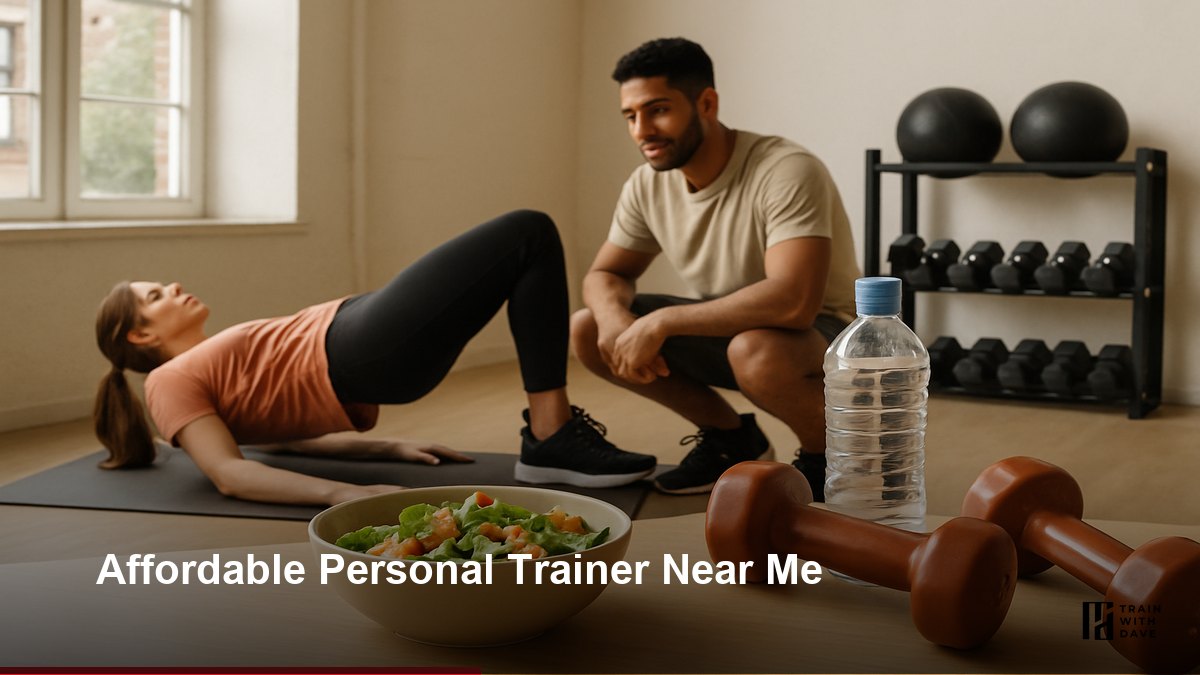
"Affordable personal trainer near me" might be the most honest search in all of fitness. You're not chasing the cheapest option — you're trying to get the most you can without setting your bank account on fire. Fair. We've coached thousands of people across Orange County, and plenty of them walked in broke: college students, new parents counting every dollar, folks between jobs. So here's the part nobody selling you a $300-a-month app wants to say out loud: most of what actually changes your body costs nothing. The coaching is for the part you can't figure out alone. Let's break down where your money matters — and where it doesn't.
What "Affordable" Actually Means (Hint: It's Not Price Per Session)
Most people compare trainers the way they compare gas stations — line up the per-session price and pick the lowest number. That's the wrong math. The real cost of a trainer isn't what you pay per hour. It's what you pay per result.
Think about it. A $40 trainer you quit after three weeks because you dreaded every session cost you $40 and zero results — which is infinitely expensive. A coach who keeps you showing up for a year and changes how you eat, train, and think about your body? That's the cheap one, even at a higher hourly rate. Adherence beats accuracy, and it beats a low sticker price too.
In our experience working with thousands of clients, the people who "saved money" by bouncing between the cheapest options usually spent the most over five years — because nothing stuck. They paid again and again to restart. The single most expensive thing in fitness is quitting.
So when you search "affordable," reframe it: which option gives you the best odds of still being consistent twelve months from now? Sometimes that's a trainer. Sometimes it's a $0 walking habit and a grocery swap. We're going to cover both, honestly, because we'd rather you get in shape than just buy something.
The Free Stuff That Does 80% of the Work
Here's the uncomfortable truth for anyone selling expensive fitness: the highest-leverage things you can do are completely free. No coach required to start.
- Walking. It's the most underrated fat-loss tool on earth, and it costs nothing. A daily walk drives your overall activity (and your appetite control) more than most people believe.
- Strength training with your own bodyweight. Push-ups, squats, lunges, planks, and pull-ups on a $20 doorway bar will build real strength for months before you ever "need" a gym.
- Sleep. Free, and it quietly governs your hunger, energy, and recovery. Most people leave huge results on the table here.
- Protein at every meal. Not a supplement thing — a grocery thing, which we'll get to.
None of this is fringe advice. The CDC's physical activity guidelines for adults land on roughly 150 minutes of moderate activity per week plus two days of strength work — a target you can hit with a pair of shoes and a floor. That's the entire foundation, and it's $0.
We see this every week at our Irvine studio: the clients who win aren't the ones with fancy equipment — they're the ones who nailed the free fundamentals first and used coaching to fine-tune from there. If you do nothing else from this article, start walking daily and add three bodyweight sessions a week. You'll be shocked how far that carries you before money ever enters the picture.
How to Eat for Results Without a Big Grocery Budget
Nutrition is where most "I can't afford to get in shape" stories fall apart — and it's also where the broke-college-kid mindset is secretly an advantage. Cheap, simple food is usually the food that gets you lean. You don't need organic anything or a meal-delivery subscription. You need protein you can afford.
Protein is the priority because it keeps you full and protects muscle while you lose fat. The International Society of Sports Nutrition's position stand on protein points to roughly 1.6 to 2.2 grams per kilogram of bodyweight per day for people training to change their physique — and you can hit that on a tight budget with boring, dependable staples:
- Eggs and egg whites
- Canned tuna and canned chicken
- Chicken thighs (cheaper than breast, just as useful)
- Plain Greek yogurt and cottage cheese
- Dried or canned beans and lentils
- Frozen vegetables (zero waste, half the price)
Eating out on a budget is its own skill, and it's very doable. We've written the whole breakdown on the cheapest ways to get 40g of protein at fast food, plus a tighter list of fast-food meals with 40g of protein under $8 — proof that "I only have eight bucks" is not the obstacle people think it is.
Our coaches teach this as the next-meal rule: the last meal is over, the next one is in your control, and the next one doesn't have to be expensive to be right. There is no good or bad food — only higher- and lower-calorie, more or less nutrient-dense. Cheap groceries fit that framework perfectly.
When a Personal Trainer Is Actually Worth the Money
We just spent three sections telling you how much you can do for free, so here's the honest counterweight: there are specific moments where a trainer pays for itself fast. It's not about willpower-for-hire. It's about buying back time, avoiding injury, and skipping months of guesswork.
A coach is worth it when:
- Your form on the big lifts is a question mark. Learning to squat, hinge, and press correctly early saves you from the kind of nagging injury that costs far more than a few sessions.
- You've been "trying" for a year with nothing to show. That's almost never an effort problem — it's a programming or consistency problem, and an outside eye fixes it quickly.
- You need accountability to exist at all. For a lot of people, a scheduled appointment with a real human is the difference between showing up and not. That's not weakness; it's just how humans work.
- You're plateaued and don't know why. A good coach diagnoses in one session what you'd spend three months testing on your own.
And here's the flip side, because we'd rather be straight with you: a trainer is not worth it if you flat-out won't show up, won't change a single eating habit, and are hoping the purchase itself does the work. It won't. We've seen well-off clients waste money this way and broke clients get incredible results — the deciding factor was never the budget. It's chemistry, not character, and it's consistency, not cash.
How to Get Coaching Value on Almost Any Budget
If you've decided coaching is worth it but the full-rate package isn't realistic this month, you have more options than the "all or nothing" framing implies. Affordable doesn't have to mean unsupervised.
- Buy fewer sessions and do more between them. A focused block of coaching to learn your program, then executing it solo with a check-in every few weeks, stretches your dollars without leaving you on your own.
- Start with a free consultation. A real assessment — your goals, your schedule, your starting point — gives you a usable plan even before you commit to anything. Use it.
- Consider online or hybrid coaching. Remote programming with a coach who answers your questions costs less than in-person sessions and still removes the guesswork.
- Ask about what's actually included. A higher hourly rate that bundles your nutrition plan, training app, and between-session access can be cheaper per result than a bare-bones cheaper rate that hands you a workout and waves goodbye.
For a fuller local breakdown of pricing and what to look for, we put together a guide to affordable personal trainers in Orange County, California that walks through the real numbers. The point of all of this: you can almost always find a version of coaching that fits where you are right now. No point in being broke and stuck when a smaller, smarter entry point exists.
Our Honest Take: Start With a Free Consultation
If you take one thing from this, let it be the reframe: don't shop for the cheapest trainer — shop for the cheapest path to results you'll actually stick with. For a lot of people, that path starts with the free stuff (walking, bodyweight strength, cheap protein) and graduates to coaching exactly where they get stuck. Both are legitimate. Neither requires you to be rich.
That's also why we don't lead with a price tag. We lead with a conversation. A free 45-minute consultation at any of our three Orange County studios — Irvine, Orange, or Laguna Hills — gets you a clear read on where you are and what would actually move the needle for your goals and your budget. No pressure, no obligation, no "sign here." If the answer is "honestly, just walk and fix your protein for a month," we'll tell you that. If coaching makes sense, we'll show you the most affordable way in.
Here's what twenty years of doing this with thousands of people has taught us: the people who get in shape aren't the ones who spent the most. They're the ones who started with what they had and got a little help at the right moment. If you're ready for that moment, book your free consultation and let's map it out together — affordably.