
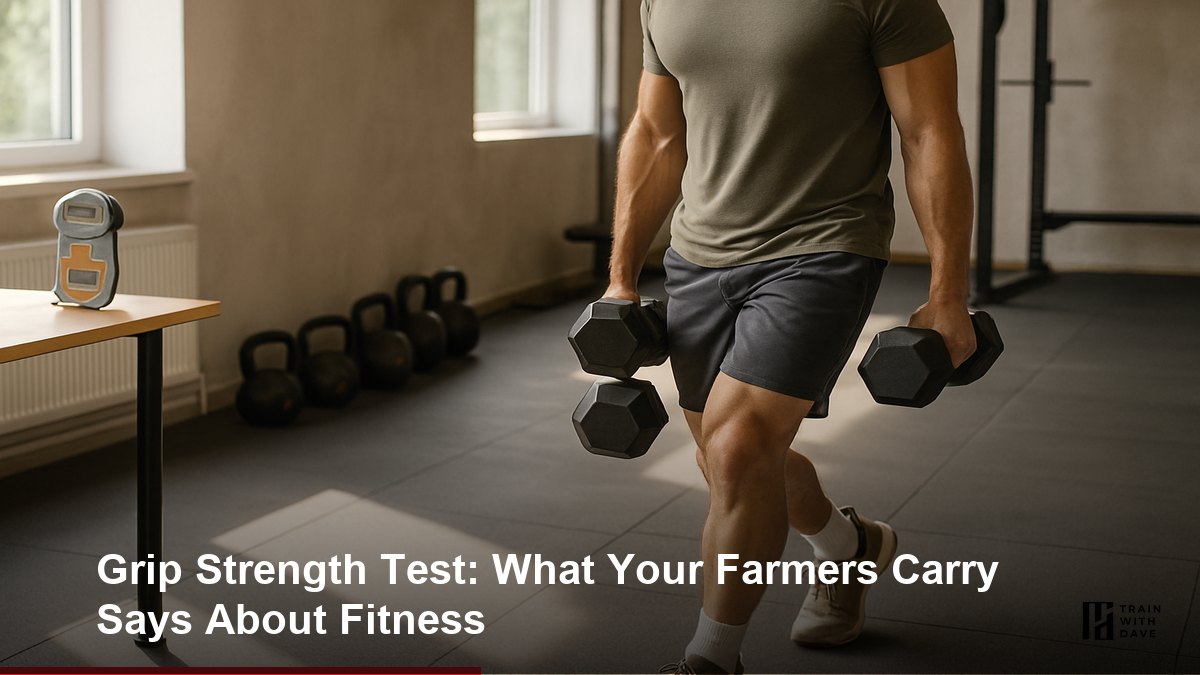
Hand someone a pair of heavy dumbbells, tell them to carry the weight to the far wall and back, and you'll learn more about their fitness in sixty seconds than a treadmill test tells you in twenty minutes.
That's the farmer's carry — pick up something heavy in each hand, stand tall, and walk. It looks almost too simple to be a real test. But it's the most honest measure of real-world strength we know of, and the first thing to quit is almost always the same: your grip.
Your hands are the connection point between your body and everything you pick up, drag, and haul through actual life — groceries up a flight of stairs, luggage through an airport, a squirming kid on each hip. When your grip goes, the whole chain goes with it. So the real question isn't just "how strong are your hands?" It's "what is your grip strength telling you about the rest of you?"
Grip strength is a full-body readout, not a hand test
Most people assume grip is a forearm-and-hand thing. It's not — or at least, that's only the surface. To hold heavy weight while you walk, your shoulders have to stay packed down and back, your core has to brace hard enough to keep your spine stacked, and your hips and feet have to produce a steady stride under load. The grip is just the first domino. When it lets go, it's often because something upstream — your posture, your bracing, your breathing — broke down a few seconds earlier.
In our experience coaching thousands of clients, the grip is the honest broker of the body. People can muscle their way through a lot of exercises with momentum, a little ego, and some creative range of motion. Nobody fakes a loaded carry. Either you can hold the weight and walk tall, or you can't. That's why our coaches teach the farmer's carry early with almost everyone — before we chase a bigger squat or a leaner waistline, we want to see the truth about where someone actually stands.
Here's the part that surprises people: grip tends to track with total-body strength. It's not magic and it's not a party trick — it's mechanics. A strong grip usually means the shoulders, back, and trunk that support it are strong too, because you can't build a genuinely powerful hand on top of a weak frame. That's why a simple carry doubles as a snapshot of your whole system.
How to run the farmer's carry test on yourself
You don't need a lab or a fancy dynamometer. You need two heavy objects you can hold at your sides and about ten yards of clear floor. Dumbbells or kettlebells are ideal, but two loaded grocery bags, water jugs, or a couple of packed duffel bags will get you an honest first read.
- Pick a load that's actually heavy. Not so heavy you can't lift it off the ground safely, but heavy enough that you feel it immediately. If you can stroll around chatting on the phone, it's too light to tell you anything.
- Stand up tall before you move. Chest up, shoulders down and back, ribs stacked over your hips. The setup is the test — if you're already hunched and rounded before the first step, that's data.
- Walk under control. Short, deliberate steps. No leaning, no waddling, no letting the weights swing you side to side. You're carrying the load, not being dragged by it.
- Measure it two ways. Either walk a set distance (say, a 40-yard round trip) and see if you can finish without setting the weights down, or hold and walk for time — 30 to 60 seconds — and notice exactly when and where you start to fall apart.
The most useful information isn't whether you "passed." It's where you failed first. Pay close attention to which link in the chain waves the white flag, because that's your next month of training pointing right at you.
What your farmers carry is telling you
Your grip gives out before anything else
This is the most common one, especially for people who spend their days at a keyboard. Your legs feel fine, your lungs are fine, but your hands are screaming and the weights are sliding out of your fingers. That's a straightforward signal: your grip is the weak link, and it's quietly capping how much you can do on every pull, row, and deadlift. The good news is grip responds fast to training — this is one of the quickest wins we see with our clients.
Your shoulders creep up toward your ears
If your traps shrug up and your neck disappears halfway through the carry, your shoulders aren't stable enough to own the load. That upstream leak shows up as neck and upper-back tightness in everyday life — the exact complaint we hear constantly from desk workers at our Irvine studio. The fix isn't a massage; it's teaching the shoulder blades to stay set under weight.
Your posture folds forward
Watch for the slow collapse: the chest caves, the low back rounds, and you finish the carry looking like a question mark. When posture folds under a moderate load, it usually means the core isn't bracing and the spine is doing a job the muscles should be doing. This is the pattern we care about most, because it's the same breakdown that turns "I just picked up a laundry basket" into a tweaked back.
You wobble, drift, or list to one side
If you can't walk a straight line, or one side clearly caves before the other, you've found a stability and balance gap — and often a left-to-right strength imbalance. Almost everyone has a stronger side; a carry makes it impossible to hide. We see with our clients that closing that gap pays off far beyond the gym, from a more confident stride to fewer stumbles carrying awkward loads.
Simple benchmarks we use with clients
Numbers are only useful if they're honest, so treat these as working targets, not gospel. In our experience, a solid standard for most healthy adults is being able to carry roughly half your bodyweight in each hand and walk about 40 yards — or hold and walk for 45 to 60 seconds — without your form falling apart. Get there and you've got a genuinely capable, athletic base to build on.
If half your bodyweight per hand feels a long way off, that's not a verdict on you — it's just your starting line. What our coaches find matters far more than the number on day one is the trend. Clients who add a little load or a little time every week or two are getting measurably stronger, and that progress shows up everywhere: hauling luggage, moving furniture, keeping up on a hike, playing with their kids without paying for it the next morning.
And this cuts against a myth we hear all the time — that grip and "carry strength" are things you inevitably lose as you get older. Capability is trainable at any age. We've coached plenty of people in their fifties and sixties who out-carry folks half their age, simply because they kept training the pattern. Strength that keeps you capable isn't reserved for the young; it's reserved for the consistent.
How to build a carry that doesn't quit
You get better at carrying by carrying — but a few deliberate pieces speed it up. Here's the short version of what we program:
- Loaded carries, twice a week. Farmer's carries are the main event, but mix in suitcase carries (weight in one hand only) to hammer the core and expose that side-to-side imbalance directly.
- Dead hangs. Just hang from a bar for time. It's the simplest, highest-return grip builder there is, and it decompresses the shoulders and spine as a bonus. Build from 15 seconds toward a full minute.
- Heavy hinging. Deadlifts and their variations build the posterior chain — hamstrings, glutes, back — that keeps you tall under load. If the hinge pattern feels shaky, work through our guide to hinge progressions and regressions before you load it heavy.
- Anti-rotation core work. Planks and carries teach the trunk to resist folding and twisting. That's the exact quality that keeps your posture from collapsing on the carry — and keeps your back safe in real life.
None of this requires living in a gym. Two or three focused sessions a week, progressed patiently, will move the needle. If you want the bigger picture on training for real-world capability at any stage of life, our breakdown of functional fitness for all ages lays out how the pieces fit together.
The bottom line
The farmer's carry is honest in a way most fitness tests aren't. It doesn't care how much you can bench for one rep on a good day, or how fast you ran a mile in high school. It asks a simpler question: can you pick up something heavy, stand tall, and go? That's the kind of strength that shows up in your actual life — and your grip is the tell.
Run the test this week. Notice where you break down first. Then train that link. If you'd rather have a coach watch your carry, spot the leak, and build the plan for you, that's exactly what we do — you can book a free 45-minute consultation at any of our three Orange County studios in Irvine, Orange, or Laguna Hills.
Frequently Asked Questions
What does grip strength say about overall fitness?
A lot, because a strong grip rarely exists on its own. Holding heavy weight demands stable shoulders, a braced core, and a steady stride, so grip tends to track with total-body strength. That's why we use a loaded carry as a quick, honest snapshot of where someone stands.
How do I test my grip strength at home?
Grab two heavy objects you can hold at your sides — dumbbells, kettlebells, or even loaded grocery bags — stand tall, and walk about 40 yards or hold for 45 to 60 seconds. Notice what quits first: your hands, your posture, or your balance. That's your starting point.
What's a good farmer's carry weight?
In our experience, a solid working target for most healthy adults is roughly half your bodyweight in each hand for about 40 yards or 45 to 60 seconds with clean form. It's a benchmark to build toward, not a pass-fail line — the trend over time matters far more than day one.
Can I improve grip strength at any age?
Yes. Carry strength is trainable well into your fifties, sixties, and beyond — we've coached plenty of clients who out-carry people half their age simply by staying consistent. Loaded carries, dead hangs, and heavy hinging, done two or three times a week, build it steadily.