Somewhere around 42, a lot of people quietly decide their body is now made of glass. A knee twinges getting out of the car. A shoulder complains after a weekend of yard work. And the conclusion is almost always the same: "I'd better take it easy — lifting will wreck my joints."
Here's the thing twenty years of coaching thousands of Orange County adults has taught us: that instinct is backwards. For most people over 40, the joints don't hurt because they trained. They hurt because they stopped. Muscle faded, the structures around the joint got weak, and the joint started absorbing loads it was never meant to carry alone. Done right, strength training isn't the thing that breaks a 45-year-old's knees — it's the thing that protects them. This is exactly the mistake we spend the most time undoing at our Irvine, Orange, and Laguna Hills studios.
Why your joints feel different after 40
Two things are happening under the hood, and neither is character failure — it's chemistry.
First, muscle leaves. Starting in your 30s, most adults lose roughly 3–8% of their muscle mass per decade if they don't train against it — a process Harvard Health describes as age-related muscle loss (sarcopenia), and it accelerates through your 40s and 50s. Less muscle means less of the built-in shock absorber that keeps your knees, hips, and shoulders from taking the full load of a squat, a stair, or a suitcase.
Second, tendons and connective tissue get a little stiffer and slower to warm up. That's why the first rep feels creaky and the tenth feels fine. It's not damage — it's a tissue that needs a runway. Both of these respond to the same treatment, and it isn't rest.
The myth: "lifting is bad for my joints"
This is the belief we fight the hardest, because it sounds responsible. It isn't. When you load a muscle progressively, the tendon, ligament, and bone around that joint adapt and get stronger too — that's the whole point. It's why major medical centers like the Cleveland Clinic list strength and range-of-motion exercise as a frontline recommendation for arthritic joints, not a thing to avoid. Strong muscles around a cranky knee take pressure off the knee.
The CDC's physical activity guidelines for adults back this up plainly: muscle-strengthening activity on two or more days a week, at every age. There's no asterisk that says "unless you're 47." The research and the clinics all point the same direction — the danger isn't the barbell, it's the recliner.
What actually hurts joints is bad loading: too much weight, too soon, through a range you can't control, with no warm-up. That's not strength training. That's ego. There's a difference, and the difference is coaching.
What joint-friendly strength actually looks like
People expect us to hand them a list of forbidden exercises. We rarely do. There's almost no movement that's universally "bad" — there's only the wrong load, the wrong range, or the wrong day for this person. Here's the framework our coaches actually teach:
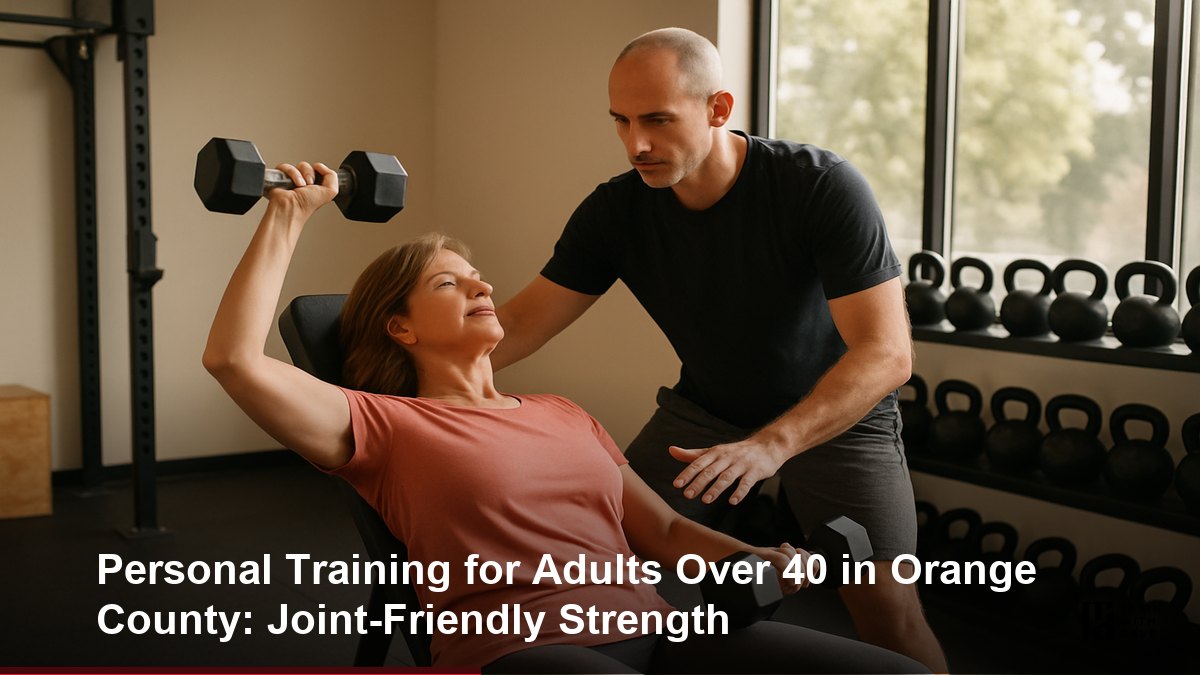
- Train the pain-free range first. If a full squat pinches but a squat to a box doesn't, we own the box version and expand the range over weeks. Full range through a range you control — not through a range that fights you.
- Warm up like it's the workout. After 40, the general warm-up and a few light ramp-up sets aren't optional — they're what turns a stiff tendon into a ready one. Skipping them is the single most common reason a lift feels "bad."
- Slow the tempo down. Controlling the lowering phase of a rep builds the tendon and teaches the joint to handle load. It also makes lighter weight feel plenty hard, which keeps you honest.
- Progress patiently. Progressive overload still works at 55 — it just moves in smaller steps. Adding a little each week beats jumping heavy and spending the next ten days iced on the couch.
- Pick tools that fit the day. Dumbbells, cables, machines, and bodyweight all build real strength. On a stiff shoulder day, a neutral-grip press or a machine can let you train hard without the joint complaining. Variety isn't a compromise — it's the point.
We watch this play out at our Laguna Hills studio constantly: someone walks in convinced their "bad knee" means legs are off the table, and eight weeks of controlled, progressive work later they're squatting deeper and pain-free — because the muscle that was supposed to protect the knee finally showed up.
The mistakes we see most often over 40
The programming is rarely the problem. The psychology is. Three patterns show up again and again:
All-or-nothing. "I can only train if I go hard four days a week, so I'll wait until things calm down at work." Things never calm down. Two solid, well-coached sessions a week, done for a year, beat a heroic month followed by quitting every single time. Adherence beats intensity.
Comparing to their 25-year-old self. The goal at 48 isn't the number you lifted in college. It's carrying groceries without your back barking, getting off the floor with your kids, hiking Crystal Cove without your knees deciding the trip. Chase capability, and the strength follows.
Treating soreness and pain as the same thing. Muscle soreness is normal and fine. Sharp, joint-specific pain is information. We teach clients to tell the two apart so they stop either pushing through the wrong signals or bailing on the right work out of fear.
Recovery is doing more work now — respect it
At 42, recovery isn't a luxury layered on top of training. It's part of the training. Two levers matter most.
Sleep is the first — the majority of tissue repair happens overnight, and a chronically short-slept body will feel every workout twice as hard. The second is protein. Holding onto muscle after 40 takes more dietary protein than it did at 25, spread across the day. We go deep on why in our guide to daily high-protein meals for longevity and clean energy — it's the nutrition side of everything on this page.
And if a specific joint is the thing holding you back, the answer is usually to strengthen around it, not to freeze it. If your low back is the limiter, start with our 8 exercises for managing chronic back pain and build from there.
How we coach the over-40 client in Orange County
There's no separate "senior" program at Train With Dave and no watered-down "over-40" track. There's your body, your history, your schedule, and a coach who calibrates the load to all three. That's the entire job. Our approach to personal training over 40 is the same customized personal training we build for everyone — the variable is you, not your birth year. If you're a woman navigating the added layers of perimenopause or postpartum recovery, our page on personal training for women in Orange County goes deeper on that.
You don't need to already be strong or already be fit to start. You need a plan that meets your joints where they are today and moves them forward on purpose. That's what the free consultation is for.
Ready to build strength your joints can live with?
Come in for a free 45-minute consultation at any of our three Orange County studios — Irvine, Orange, or Laguna Hills. We'll look at how you move, talk through your history and goals, and map a joint-friendly plan built for the body you have now.
No pressure. No commitment. Just a real conversation about your goals.
Frequently asked questions
Is it safe to start strength training after 40 if I've never lifted before?
Yes — and it's one of the highest-payoff things you can do at this age. The key is starting with loads you can control through a pain-free range and progressing slowly. That's exactly what a coach is for: getting the dose right so you build strength instead of aggravating something.
I already have knee or shoulder issues. Should I avoid weights?
Usually the opposite. Strengthening the muscles around a cranky joint typically takes pressure off it — which is why medical centers recommend strength and range-of-motion work for arthritic joints. We train the pain-free range, pick joint-friendly tools, and expand from there. Clear anything acute with your physician first.
How many days a week do I need to train?
The CDC guideline of two-plus muscle-strengthening days a week is a genuinely effective floor. Two well-coached sessions done consistently for a year beat four intense ones you quit after a month. Consistency is the whole game after 40.
How much does personal training cost in Orange County?
Train With Dave averages $60 to $80 per session — and that includes your fully customized workout program, personalized nutrition plan, training app, and direct access to your trainer between sessions. Exact pricing is set during your free consultation.
Where are Train With Dave's studios?
Three Orange County locations: Irvine, Orange, and Laguna Hills. Each offers a free 45-minute consultation.