If you typed "strength and conditioning coach near me" into Google, you probably aren't shopping for a workout buddy or a $20-a-month gym membership. You want someone who can actually program — periodize a lift schedule around your body, your job, your sleep, your knees — and hold you accountable in person. We've been doing exactly that across our Irvine, Orange, and Laguna Hills studios since 2009. This guide covers what a strength and conditioning coach actually does, the six things any coach worth hiring will deliver, the questions to ask before signing a contract anywhere in Orange County, and what a real beginner program should look like.
What a Strength and Conditioning Coach Actually Does
"Strength and conditioning coach" used to be a job title that only existed at universities, pro teams, and Olympic training centers. Then the general fitness world caught up. Today, the phrase describes any coach who programs intentionally — pairing resistance training with conditioning work so the two reinforce each other instead of canceling each other out. That's the part most people miss when they search "strength and conditioning coach near me." They aren't shopping for a workout buddy. They're shopping for someone who can write a 12-week plan that actually moves them forward.
The National Strength and Conditioning Association — the leading professional body in the field — defines the role as the application of evidence-based programming to improve athletic performance, body composition, and injury resilience. A screen-printed "trainer" who runs you through a circuit of dumbbell curls and battle ropes isn't doing that. A real S&C coach picks exercises with a reason, sequences them across the week so you can recover between sessions, and writes progression rules so you know exactly what to do next Tuesday. It's chemistry, not character — the programming either makes sense biologically or it doesn't.
In our experience working with thousands of clients across Orange County, the single biggest reason new lifters stall isn't effort. It's random programming — a different workout every week with no theme, no progression, no rest. A coach's job is to remove that randomness from your week so you can show up, do the work, and trust the math.
The Six Things Any Real S&C Coach Should Deliver
The label "strength and conditioning coach" is unregulated. Anyone can put it on a website. Here's what separates a serious coach from a personality:
- A written program with progression baked in. Not "today we're going to do legs." A document with sets, reps, target loads, and a rule for what changes next week. The American College of Sports Medicine's physical activity guidelines describe 2–3 resistance training sessions per week, hitting all major muscle groups, with progressive overload. Your coach should be able to show you their plan on paper.
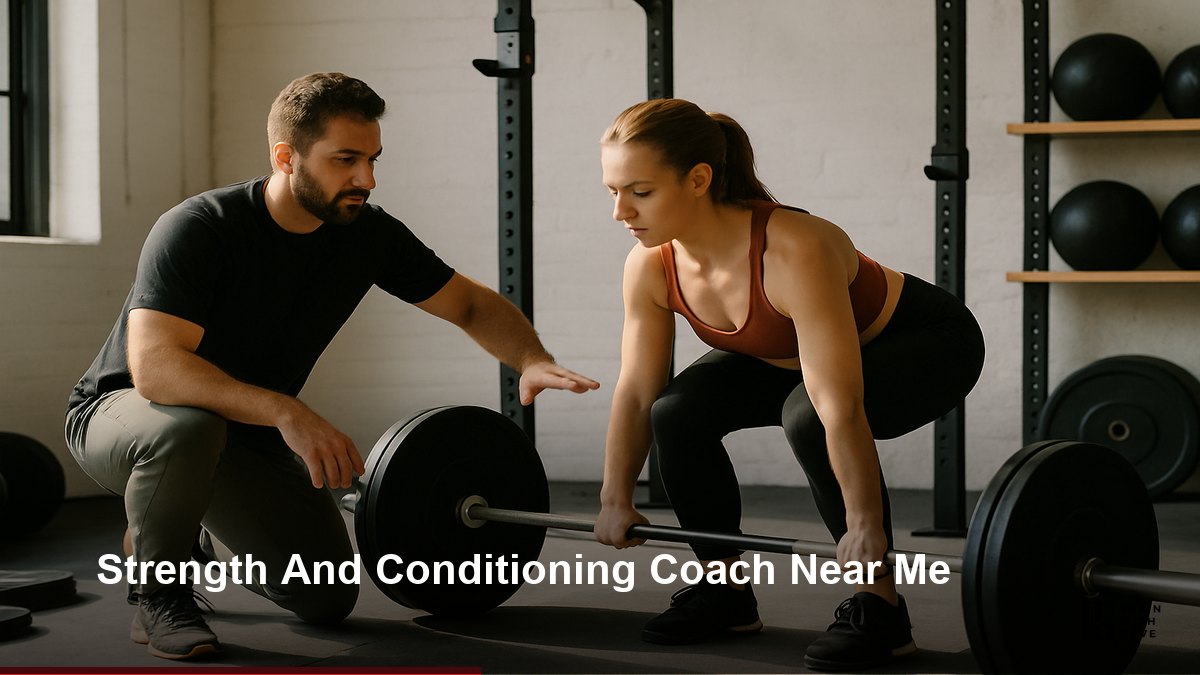
- Hands-on technique work. Squat depth, hip shift on a deadlift, scap retraction on a row — these are corrected with cues and tactile feedback, not YouTube. We see this every week at our Irvine studio: clients who've trained themselves for years finally clean up a movement pattern in a single in-person session.
- Recovery management. Sleep, soreness, deload weeks. If your coach pushes you to "go hard" every session for six months straight, they don't understand recovery — and you'll end up either hurt or burned out.
- Honest nutrition guidance. A strength program without nutrition is half a plan. Your coach doesn't need to be a registered dietitian, but they should be able to talk you through protein, calories, and meal timing without quoting fad diets.
- Adjustments when life happens. Travel, work stress, a sprained ankle — your program should bend. A coach who hands you the same template every month isn't coaching, they're proofreading.
- Real accountability. They notice when you skip. They check in. They're a person, not a PDF.
Adherence beats accuracy. A perfect program you don't follow loses every time to a decent program you actually run.
How to Vet a Strength and Conditioning Coach Near You
Before you book anywhere — our place or any other — ask four questions:
- "What's your education and certification?" Look for a Kinesiology or Exercise Science degree, or a nationally recognized S&C certification from NSCA, ACSM, or NASM. A real coach will tell you their background without hesitation.
- "Can I see a sample program?" If they can't show you a written 4–12 week plan, walk out.
- "How do you progress someone over six months?" A good answer involves periodization, deload weeks, and phases tied to a goal. A bad answer is "we just keep adding weight."
- "What do you do when someone hits a plateau?" Programming changes — not "more cardio."
Red flags: a coach who promises a specific number of pounds lost in a specific window, one who pushes supplements as the foundation of the plan, one who avoids talking about technique. Our coaches teach the team to be transparent — if we're not the right fit for someone, we say so out loud. Clients who walk into our Orange studio with active back pain or a recent surgery are sometimes better served by a physical therapist or rehab specialist first, and we'll point them there.
The Mayo Clinic's overview of strength training is a useful sniff test — if a coach's philosophy lines up with what Mayo describes (compound lifts, gradual progression, recovery, full-body weekly coverage), you're talking to a real one. If they're selling something that contradicts those basics, you have your answer.
What a Beginner Strength Program Should Actually Look Like
Most people who hire an S&C coach are not athletes. They're a 38-year-old engineer who hasn't lifted in a decade, or a 52-year-old mom who wants to keep up with her kids without a back injury. Beginner programming for that person is straightforward and boring on purpose.
The U.S. Physical Activity Guidelines and the CDC adult activity recommendations both call for muscle-strengthening activity on 2 or more days per week, plus 150 minutes of moderate-intensity cardio. That's the baseline. A practical plan we run with new Orange County clients looks like this:
- 3 resistance sessions per week, full-body, 45–60 minutes each.
- 2–3 compound lifts per session — a squat or leg-press variation, a hinge (deadlift / RDL), a push (bench or DB press), and a pull (row or pulldown).
- Progressive overload — add weight, reps, or a set when you hit your prescribed rep range with clean form.
- Light conditioning — 20–30 minutes of zone-2 cardio (walking, biking, incline treadmill) on 2 of the off days.
- A deload week every 4–6 weeks — lighter loads and fewer sets, so connective tissue can catch up to muscle.
If you're new to lifting and worried about getting "bulky" or unsure how to start, our woman's guide to lifting weights without bulk walks through exactly what changes (and what doesn't) when you add resistance training. The short version: muscle is hard to build on purpose, let alone by accident. The fear of "getting big" is almost never the actual obstacle — under-eating protein and skipping sessions are.
Why "Near Me" Matters More Than You'd Think
You can hire a coach over Zoom. You can buy a $29-a-month app. We've worked with both, and they have a place — especially for advanced lifters who already know how to move. But for the average person Googling "strength and conditioning coach near me," local is the right instinct, and here's why:
Form correction is a contact sport. Watching yourself on a phone tripod is not the same as a coach's hand on your scap telling you to brace. We see this every week — a client we've been coaching remotely for six weeks walks into our Laguna Hills studio for an in-person session, and we fix three things in 20 minutes that wouldn't have surfaced for another month over video.
Showing up to a place beats logging into an app. When the studio is on your route home and your coach is expecting you at 5:30, you go. When the workout is on your phone, you negotiate with yourself — and you lose. We're not robots. The environment does half the work.
Equipment matters. Squat racks, sleds, dumbbells up to 100+ lbs, glute-ham developers — most home setups can't replicate a real strength environment. Three to six months in, you'll outgrow what you can do at home, and the program will start to ceiling.
Local community is a quiet accelerant. Clients see other clients progressing in the same room. Adherence climbs. That's part of why our best personal training programs for beginners in Orange County page goes into detail on how the studio environment shapes the first 90 days.
What to Expect at a Free Consult at Train With Dave
If you book a free 45-minute consultation with us at our Irvine, Orange, or Laguna Hills studio, here's what actually happens — no surprises, no pressure:
- A real conversation about your goals. Not a sales pitch. We'll ask about your training history, what you've tried, what stuck, what didn't, and what would make this round different.
- A movement screen. We watch how you squat, hinge, push, and pull. This tells us more about where to start than any questionnaire.
- A look at your schedule and life. Three sessions a week is non-negotiable for most beginners. If your calendar can't support that, we'll say so honestly.
- A nutrition snapshot. Not a meal plan on the spot — just enough conversation to know whether we're building on a solid base or starting from scratch. For new clients who want to dial in food at the same time, our beginner's guide to custom meal planning for fitness is the framework we hand out.
- A clear yes or no. We tell you whether we're a fit. If we're not — because you live an hour away, because you need a specialist, because the timing isn't right — we'll tell you that too. No point in selling something you won't use. No point in being lean if you're miserable.
After 20 years of doing this with thousands of people in Orange County, the playbook we hand new clients is the same one we'd hand a friend: lift heavy enough things 2–3 times a week, eat enough protein, sleep, and stay consistent for long enough to see the math compound. A real strength and conditioning coach near you should make that simple — not sell you a 12-week miracle.