

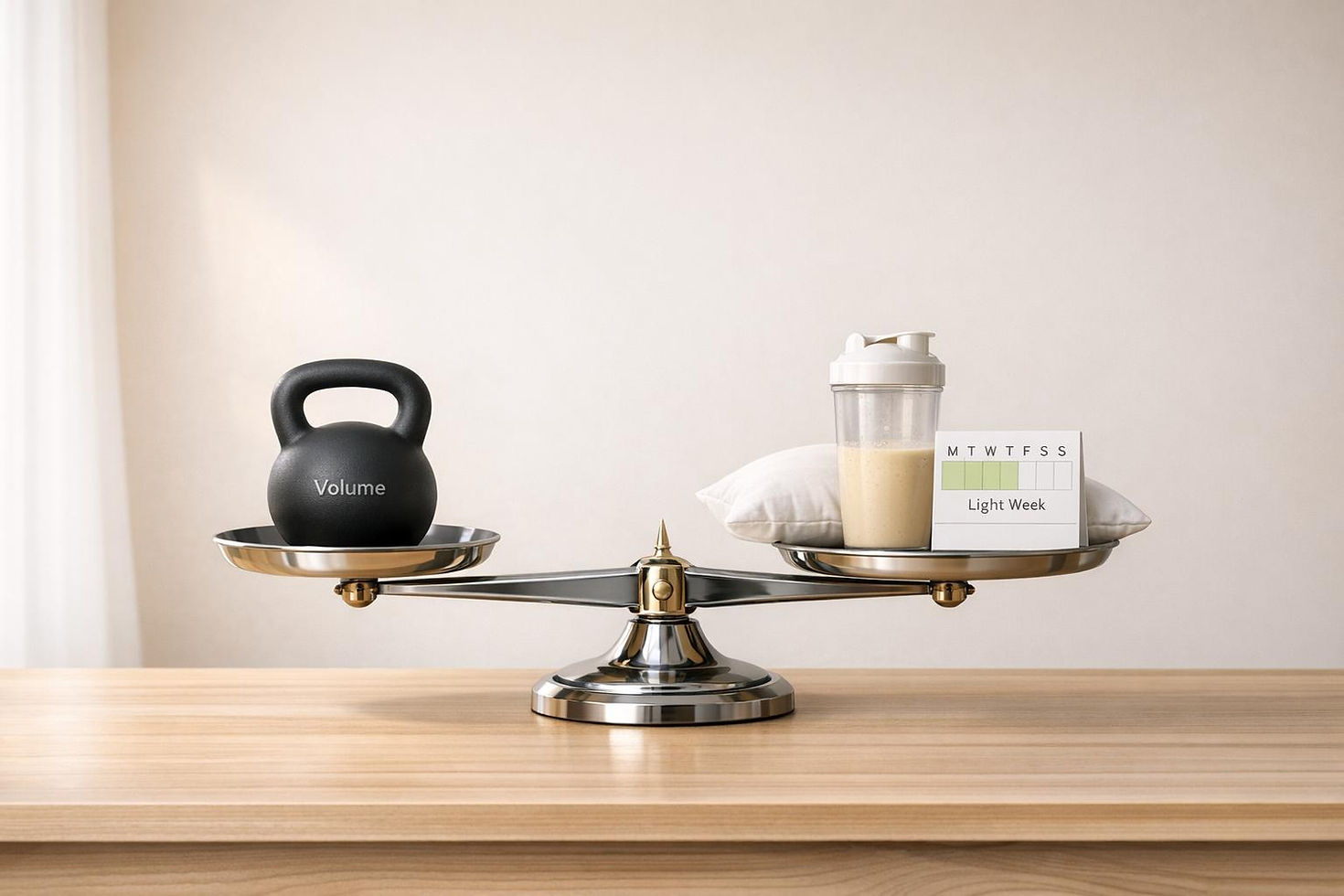
How to Balance Training Volume and Recovery
- David Cozzens
- 14 hours ago
- 10 min read
Balancing training volume and recovery is the key to building muscle effectively while avoiding injuries and burnout. Here's what you need to know:
Training volume refers to the total work you do, often measured in hard sets (10–20 sets per muscle group per week is ideal for most).
Recovery is when muscles repair and grow, requiring 7–9 hours of sleep, proper nutrition (1.6–2.2g protein per kg body weight), and hydration.
Overtraining occurs when recovery can't keep up with training, leading to soreness, fatigue, and performance drops.
Beginners should start with 6–12 sets per muscle group weekly, while advanced lifters may need up to 25+ sets, depending on experience and goals.
Rest days, deload weeks, and stress management are critical for long-term progress.
To improve results, gradually increase volume over time, monitor your body's signals, and prioritize recovery strategies like sleep, nutrition, and rest days. This balance ensures steady gains without hitting a plateau or risking overtraining.
Training Volume and Recovery Basics
What Training Volume Means
Training volume refers to the total amount of work you do during your workouts. For muscle growth, one practical way to measure it is by counting hard sets - sets performed within 0–4 reps of failure, usually at an RPE (Rate of Perceived Exertion) of 7 or higher. Another common method is calculating tonnage, which multiplies sets, reps, and weight. For example, performing 3 sets of 10 reps with 100 pounds results in a total of 3,000 pounds of work.
A more detailed method is fractional volume counting, which assigns partial credit to secondary muscles involved in compound lifts. For instance, a barbell row might count as 1.0 set for your back but only 0.5 sets for your biceps. This helps prevent overworking smaller muscle groups and keeps your training balanced. Research suggests aiming for 10–20 hard sets per muscle group per week to maximize gains. While most people thrive in this range, maintaining muscle requires far less - about 2–3 fractional sets weekly [1].
Understanding your training volume is only part of the equation. Recovery is the other half of the story.
How Recovery Works
While training provides the stimulus for growth, recovery is what allows you to actually build muscle. During workouts, your muscle fibers develop microscopic tears. It’s during rest that these tears are repaired, making your muscles stronger and larger. This process, known as supercompensation, is how your body adapts to training by improving its capacity to handle future workouts [4][6].
Recovery also involves repairing your central nervous system and connective tissues, which reduces the risk of injury. To support this process, aim for 7–9 hours of sleep per night, as this promotes growth hormone release and tissue repair. Nutrition is equally critical - consume between 1.6–2.2 grams of protein per kilogram of body weight (or 0.7–1.0 grams per pound). Since muscle tissue is largely water, staying hydrated is essential for optimal recovery.
"You don't get stronger in the gym; you get stronger when you recover from the gym." – Speediance [5]
What Happens When Volume and Recovery Are Imbalanced
If you push beyond what your body can recover from, your progress will stall - or worse, you could lose muscle and strength. One of the first red flags is persistent muscle soreness that doesn’t fade between workouts. This is often paired with joint discomfort or minor tendon issues. Another sign is a noticeable drop in performance, like struggling to hit your usual rep counts. For most natural lifters, the Maximum Recoverable Volume (MRV) typically falls between 20–25 sets per muscle group each week [6].
Overreaching can also affect your mood and motivation. Other symptoms include trouble sleeping and an elevated resting heart rate, both signs of systemic fatigue. Stressful periods in life can amplify these effects, meaning even a slight increase in training volume may push you into overtraining. To avoid burnout, it’s wise to scale back to maintenance levels - around 4–6 sets per muscle group - when needed [4].
sbb-itb-9351f62
Training Intensity & Volume to Balance Gains and Fatigue | Mike Israetel
Adjusting Training Volume for Your Experience Level
Starting Guidelines for Beginners
If you're just starting out, your body responds well to lower training volumes. Performing 6–12 sets per muscle group each week is enough to build muscle while allowing you to focus on the essentials: proper form and building a solid foundation[3][7]. Sticking to the lower end of this range is a smart move - it gives you plenty of room to grow over time without hitting a plateau too soon.
At this stage, it's crucial to prioritize quality over quantity. Avoid jumping into high-volume training (like 20+ sets per week) too early. Overdoing it can lead to poor recovery and slow down your progress. Instead, focus on mastering your technique and building your body's capacity for future challenges.
Volume Strategies for Intermediate and Advanced Lifters
Once you've been training consistently for 1–3 years, your body needs more work to keep progressing. At this intermediate level, aim for 10–18 sets per muscle group weekly. For advanced lifters - those with 3+ years of experience - this can increase to 15–25+ sets per muscle group[1][8].
That said, there's a limit to how much your body can handle overall. The systemic ceiling for most people is around 100–200 total hard sets per week across all muscle groups. Pushing beyond this can lead to issues like poor sleep, decreased motivation, and joint strain. Advanced lifters often tackle this by using specialization phases. During these phases, they focus on certain muscle groups, pushing them to higher volumes (15–25 sets), while keeping other muscles at maintenance levels (4–8 sets). This approach helps balance recovery and long-term progress.
Experience Level | Training Age | Weekly Sets per Muscle | Total Weekly Sets | Primary Focus |
Beginner | 0–1 Years | 6–12 Sets | 80–120 Sets | Form and conditioning |
Intermediate | 1–3 Years | 10–18 Sets | 100–160 Sets | Progressive overload |
Advanced | 3+ Years | 15–25+ Sets | 100–180 Sets | Specialization phases |
Increasing Volume Gradually Over Time
To safely increase training volume, adopt a gradual approach. Start each training block with 8–10 sets per muscle weekly (your Minimum Effective Volume, or MEV) and add 1–2 sets per week as your body adapts. Keep an eye on your performance - if it starts to decline, it's a sign you've reached your limit[2][4].
When you notice signs of overreach, such as fatigue or lack of progress, scale back. A deload week - where you cut your volume by roughly 50% - can help you recover and maintain steady gains[2][3]. If you've been training at high volumes for months without seeing results, consider taking a two-week active rest period. Afterward, restart with a reduced set count, around half of your previous workload. This "resensitization" phase allows your body to recover and prepares you for the next training cycle[1].
How to Recover Properly
Effective recovery is the missing piece that ensures your training efforts lead to muscle growth while avoiding burnout. Managing recovery is just as important as managing your training volume.
Scheduling Rest Days and Deload Weeks
Your body needs 1–2 full rest days each week to repair and rebuild muscles. Skipping these can hinder your progress and increase the risk of overtraining.
In addition to weekly rest, plan for deload weeks. These are 5–7 day periods where you intentionally reduce training stress. The ideal approach is to cut your set volume by 40–60% while keeping your weights at 85–90% of your usual load. This strategy helps you maintain strength and movement patterns while giving your body a chance to recover from accumulated fatigue[9][11].
How often should you deload? It depends on your experience level:
Pay attention to warning signs that signal the need for a deload. If your strength drops for two or more sessions, your joints ache persistently, your sleep is disrupted, or you lose motivation to train, it’s time to scale back. Another helpful metric is your resting heart rate. If it’s consistently 5+ beats per minute higher than usual for 2–3 mornings, your body is likely overworked and needs recovery[10][11].
"Training adds both fitness and fatigue to your system. A deload strategically removes the fatigue while keeping the fitness." - Mesostrength[12]
Once rest days and deloads are in place, you can focus on the other pillars of recovery: sleep and nutrition.
Sleep and Nutrition for Recovery
Sleep is your body’s repair shop. During deep sleep, 70–80% of your daily growth hormone is released, fueling muscle repair and growth[14]. To maximize recovery, aim for 7–9 hours of sleep per night. If you’re training intensely, bump that up to 8.5–10 hours. Why? Research shows that sleeping 5.5 hours instead of 8.5 hours can lead to 60% less muscle mass preserved during a calorie deficit[13][14].
To improve sleep quality, keep your room cool (65–68°F), avoid blue light for an hour before bed, and skip caffeine after 2:00 PM. Nutrition plays an equally important role:
By combining proper sleep and targeted nutrition, you set the stage for your body to bounce back stronger.
Reducing Stress to Improve Recovery
Stress from daily life can derail your recovery. Work deadlines, personal conflicts, or financial concerns elevate cortisol levels, which disrupt sleep and reduce your ability to handle training volume[10]. During particularly stressful times, consider scaling back your workouts to avoid adding physical stress on top of mental stress.
Relaxation techniques can help shift your body into recovery mode. Try 2–5 minutes of slow breathing or spend 10 minutes in sunlight to calm your nervous system. Set a "wind-down" alarm an hour before bed, dim the lights, and engage in low-stimulation activities like reading or stretching. Even on rest days, light movement such as 20–40 minutes of walking or easy cycling can boost blood flow and help clear out metabolic waste without overloading your system[15][16].
"Training does not make you fitter - recovery after training does." - FITIV Pulse[16]
Train with Dave: Personalized Training Programs
Train with Dave takes a personalized approach to fitness, combining proven recovery strategies with customized training plans to help you achieve your goals.
Custom Training and Recovery Plans
At Train with Dave, every program starts with a data-driven assessment to create the perfect balance of training and recovery. Your journey begins with a complimentary 45-minute consultation at one of three Orange County locations: Irvine, Laguna Hills, or Orange. During this session, trainers evaluate key factors like work capacity, stress levels, sleep quality, and diet to design a plan tailored to your body.
Real success stories highlight the program’s effectiveness. One client gained 18 pounds of muscle and reduced body fat to 13% in just four months by optimizing their training and recovery balance. Another client, Richard, overcame chronic low back and hip pain caused by powerlifting injuries through a combination of corrective exercises and structured recovery.
"Each Personal Training program is not only customized towards your goals, but is created to fit your lifestyle. I will not only get you to your goal, but also educate you on the process so you can maintain the body you've always wanted." – David, Founder of Train with Dave [17]
Working with Exercise Physiologists
The team at Train with Dave includes college-educated exercise physiologists who specialize in body transformation and corrective exercise. They use measurable data - like total challenging sets and volume load - to fine-tune your workouts and monitor fatigue. Adjustments are made based on both your progress and feedback to ensure your training stays effective and aligned with your recovery needs.
This attention to detail has earned Train with Dave the title of Best Personal Training in Orange County for four years straight (2022–2025). With over 1,000 five-star reviews, the program’s reputation speaks for itself.
Starting Your Training at Train with Dave
Ready to start? Schedule your complimentary 45-minute consultation at trainwithdaveoc.com to begin your personalized training program. Whether your goal is building muscle, increasing strength, or managing chronic pain, trainers use advanced methods to assess your needs and create a custom plan. Sessions start at $60 and include ongoing support through a progress-tracking app.
"Every weapon in our armory, from our college-educated trainers to our data analytics technology, is meant to produce the best outcomes in the shortest amount of time." – Train with Dave [17]
Finding Your Sweet Spot for Muscle Growth
Sustainable muscle growth revolves around balancing volume, recovery, and gradual progression. While most lifters see success with 10–20 hard sets per muscle group per week, your optimal range depends on factors like sleep quality, stress levels, and training history [2][18]. The best approach? Start with your Minimum Effective Volume (around 8–10 sets), gradually increase over 4–6 weeks, and keep an eye out for signs like reduced performance or joint discomfort before hitting your Maximum Recoverable Volume [2].
Recovery is just as crucial as the work you put in at the gym. Prioritize 7–9 hours of sleep per night, ensure you're consuming 1.6–2.2 grams of protein per kilogram of body weight, and include deload weeks every 4–8 weeks [5][18]. These habits not only support long-term progress but also help you avoid plateaus and the risk of overtraining.
Remember, what works for one person might not work for another. The key is tailoring these principles to your individual needs. Expert guidance can make this process easier by using data-driven methods to fine-tune your training volume and recovery strategies as you progress.
If you're ready to take the guesswork out of your training, Train with Dave offers personalized programs designed to balance volume and recovery for your goals. Schedule a complimentary 45-minute consultation at trainwithdaveoc.com and start building a program that works for you at one of their Orange County locations.
FAQs
How do I find my MRV without overtraining?
To figure out your MRV without pushing into overtraining territory, you'll need to keep a close eye on your training volume - this means tracking your sets, reps, and the weight you're lifting. Start by gradually increasing your training volume over time. Pay attention to how your body responds.
If you begin to experience persistent fatigue, ongoing muscle soreness, or a drop in performance, that's a sign you've gone beyond what your body can handle. Dial it back slightly to stay within your MRV.
Keeping tabs on your recovery, sleep quality, and overall progress is key. This way, you can fine-tune your training to build muscle effectively while steering clear of overtraining.
How do I count weekly sets for compound lifts?
When tracking your weekly training volume, count every set performed close to failure as a "hard set." For compound exercises, assign 1.0x to the primary muscles worked and 0.5x to the secondary muscles involved. This method helps you accurately monitor the total weekly sets for each muscle group, ensuring you stay within the ideal range for muscle growth and recovery.
Should I add sets or take a deload when progress stalls?
When your progress hits a wall, taking a deload week often works better than piling on extra sets. A deload means cutting back your training volume by about 40–60% or dialing down the intensity. This gives your body the chance to recover, helps stave off overtraining, and can lead to better performance in the long run. While adding sets might help occasionally, signs like lingering fatigue, joint discomfort, or waning motivation are clear signals to focus on recovery through a deload instead.


Comments